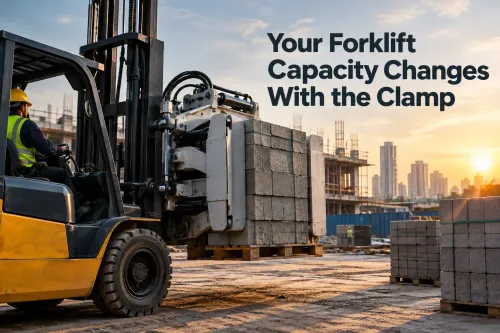

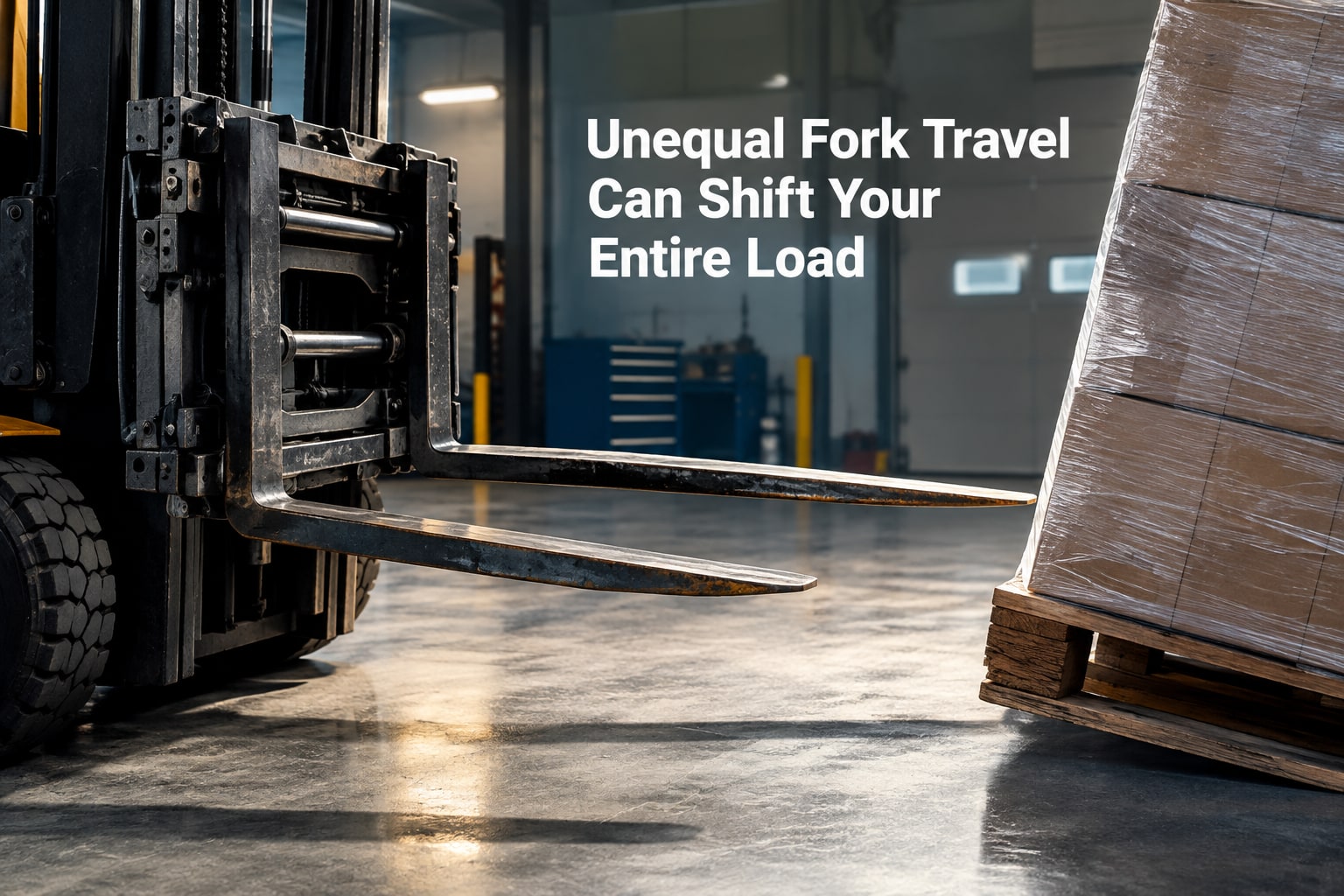
A fork positioner can leave one fork behind, shift a load off-centre, or enter pallet openings at different angles even when the operator commands both forks together. You will learn how to separate attachment faults from pallet and load problems, measure the error, and identify when the repair requires hydraulic testing, mechanical replacement, or a carriage-fit correction.
Key takeaways
- Check whether the pallet is crooked before blaming the fork positioner.
- Measure fork travel on both sides to confirm uneven movement.
- Inspect hydraulic leaks, hose routing, pins, rollers, and carriage fit.
- Repair misalignment before lifting loads that could slip or fall.
What misalignment looks like—and whether the attachment or load is at fault
The query “why does a fork positioner for misalign loads material handling equipment in delhi” covers two different faults: the attachment may move its forks unevenly, or the pallet and load may already be crooked.
A fork positioner changes fork spacing; it does not centre the attachment on the truck, square the forks to a pallet, or straighten a skewed load.
Misalignment appears as:
- One fork stopping before the other, moving slower, or travelling farther
- Unequal spacing between the fork shanks or tips
- Forks drifting apart or together while carrying a load
- A load sitting off-centre despite equal fork spacing
- Fork tips failing to enter both pallet openings squarely
Park the forklift, isolate its power, and remove the load before testing. Measure fork spacing and tip height, then inspect the attachment frame, carriage locks, hoses, cylinders, pins, guides, and fork hooks. Test the positioner unloaded and compare left-to-right travel.
If both forks move together but a known, evenly loaded pallet still sits square, inspect pallet damage, uneven pockets, load placement, fork insertion depth, aisle clearance, and operator visibility. A damaged pallet can make a sound attachment look faulty; using fork spacing to compensate can create point loading and instability.
Never raise hydraulic pressure to mask unequal travel before identifying the defect.
The first checks for a fork positioner that is not aligning
Before adjusting anything, isolate the fault from the load and make the forklift safe. Treat a fork positioner not aligning as an attachment problem only after you have removed the pallet and confirmed the forks themselves move unevenly.
1. Park on level ground, lower the forks, apply the parking brake, switch off the truck, and relieve hydraulic pressure according to the truck manual. Remove the load and keep people outside the attachment’s movement area.
2. Clean debris from the attachment and inspect the frame, carriage contact points, fork hooks, pins, guides, hoses, and cylinders. Confirm the attachment matches the truck’s carriage class and that the upper hooks, lower locks, and mounting points are fully engaged.
3. Return any side-shift function to mechanical centre before checking fork spacing. Measure the distance between fork tips and heels, then compare tip height; spacing alone can hide an attachment sitting crooked on the carriage.
4. Test the unloaded positioner at low engine speed. Compare left and right travel, stopping points, speed, drift, and whether both forks remain level. Do not raise relief pressure to cure unequal movement; check pressure and flow against the attachment and truck specifications.
5. If movement is unequal, inspect for restricted hoses, air, oil contamination, leaking seals, damaged synchronising components, bent parts, or worn guides before replacing seals or making adjustments.
6. Test the corrected movement with a sound, evenly loaded pallet. Insert both forks level and fully, then confirm the load remains centred without using fork spacing to compensate for a skewed pallet.
Hydraulic and mechanical faults that create unequal fork travel
One fork moving farther or slower points to unequal hydraulic flow, cylinder resistance, or a mechanical obstruction—not a bad pallet alone. Compare both forks unloaded, then under the same evenly distributed load; note whether the error follows one cylinder or remains on one side of the carriage.
| Fault | What you will see | What to inspect |
|---|---|---|
| Internal cylinder bypass | One fork creeps, stops short, or drifts under load | Worn piston seals, scored barrel, and oil leaking past the piston |
| Unequal cylinder friction | One side starts late or moves in jerks | Bent rod, damaged gland, contaminated oil, or different seal drag |
| Restricted flow | One fork is consistently slower | Crushed hose, blocked fitting, kinked tubing, or a damaged quick coupler |
| Air or poor synchronisation | Spongy, uneven, or changing travel | Trapped air, low oil, contaminated oil, or a damaged flow-divider or synchronising circuit |
| Mechanical binding | Movement stops at the same point every time | Bent guide, seized pin, worn bush, debris, or a tight fork hook |
| Poor attachment fit | Both forks appear uneven relative to the truck | Incorrect carriage class, loose upper hooks, missing lower retainers, or an unlocked attachment |
Do not raise the relief-valve setting to force a slow fork. Excess pressure can exceed the attachment rating, increase hose and cylinder loads, and worsen seal leakage; check pressure and flow against the truck and attachment specifications.
For fork positioner misalignment troubleshooting in Delhi, isolate the truck, remove the load, clean the attachment, and compare fork spacing and tip height. Test movement unloaded before inspecting hoses, cylinders, pins, guides, and locking parts, then confirm performance with a known, square pallet.
Carriage fit, fork condition, and measurement checks that visual inspection misses
A fork positioner can look square while poor carriage fit or worn forks shift every load. Match the attachment to the truck’s carriage class and check upper hook dimensions, lower retainers, locking components, and carriage contact surfaces. A loose hook or incomplete lock lets the frame sit skewed, so both forks appear to travel unevenly.
Clean packed grit, water residue, and dried lubricant from the carriage and guides before measuring. In logistics forklift attachments in Delhi, debris can create a repeatable spacing error that looks like failed hydraulic synchronisation.
- Measure fork spacing at the heels and tips, then compare left and right tip height. Measure parallelism with the forks unloaded and level; a visible gap at one end is not an acceptable substitute for a measurement.
- Inspect fork heels, shanks, hooks, and tips for thinning, bending, cracks, or unequal wear. A tapered or bent fork can enter one pallet opening while the positioner remains correctly aligned.
- Centre the side-shift attachment mechanically before checking spacing. Worn guides or a side-shift frame that stops off-centre makes the forks appear misaligned.
- Test with a square, undamaged pallet and an evenly distributed load. Broken deck boards, stretched stringers, or an off-centre load can deflect the forks or skew the pallet even when measured parallelism is correct.
If unloaded travel is parallel but the known pallet shifts, investigate pallet condition, insertion depth, and load stability rather than recalibrating the positioner.
When a forklift attachment repair is needed—and what the repair should cover
Repair is needed when cleaning and correct adjustment do not restore equal, repeatable fork travel, or when a defect threatens load support. Clean the carriage, guides, pins and attachment before measuring; packed grit can create a repeatable spacing error that looks like hydraulic synchronisation failure.
| Option | What it means | When it applies |
|---|---|---|
| Cleaning | Remove grit, rust, water and contaminated lubricant; inspect for blocked guides | Forks move unevenly because debris prevents smooth travel |
| Adjustment | Set mounting, guide clearance, fork spacing, side-shift centre and locking points | Components are intact but alignment or installation is incorrect |
| Replaceable wear parts | Renew seals, hoses, bushes, guide components, pins or locking parts | Wear, leakage, looseness or restricted movement is confirmed |
| Approved repair or replacement | Follow the attachment maker’s repair limits or fit a replacement assembly | Fork arms, hooks, weldments or carriage plates are cracked, bent or deformed |
Do not increase hydraulic pressure to cure slow movement. Check pressure and flow against the attachment and truck specifications; a higher relief setting can overload cylinders and hoses and worsen leakage. Demand a travel test without a load and a final parallelism measurement.
For forklift attachment repair in Delhi, ask K. S. Enterprises or another qualified provider to record the failed component, measured clearances, hydraulic readings and parts fitted. Reject local welding on a load-bearing crack unless the manufacturer has approved the procedure in writing.
Related product
 | Forklift Attachments K. S. Enterprises is a trusted supplier of premium-quality Fork Positioners, providing advanced forklift attachment solutions for warehouses,... View product → |
Frequently asked questions
How can you tell whether the attachment or load caused misalignment?
Check the pallet, load overhang, and fork entry first, then compare fork spacing and travel. A crooked load points to loading or pallet conditions; unequal fork movement points to the attachment or carriage.
What should you check first when a fork positioner is not aligning?
Park safely, release hydraulic pressure, inspect for leaks or obstructions, and measure each fork’s movement from a fixed carriage reference. Compare the readings with the attachment manufacturer’s specifications.
Which faults create unequal fork travel?
Unequal travel can result from hydraulic cylinder or hose problems, restricted flow, damaged pins, seized rollers, bent fork-positioner components, or mechanical wear on one side.
When does a forklift attachment need repair?
Arrange repair when forks move unevenly, the attachment leaks, components are bent or cracked, rollers bind, or measurements show excessive wear. The repair should address the failed parts and verify alignment under load.