
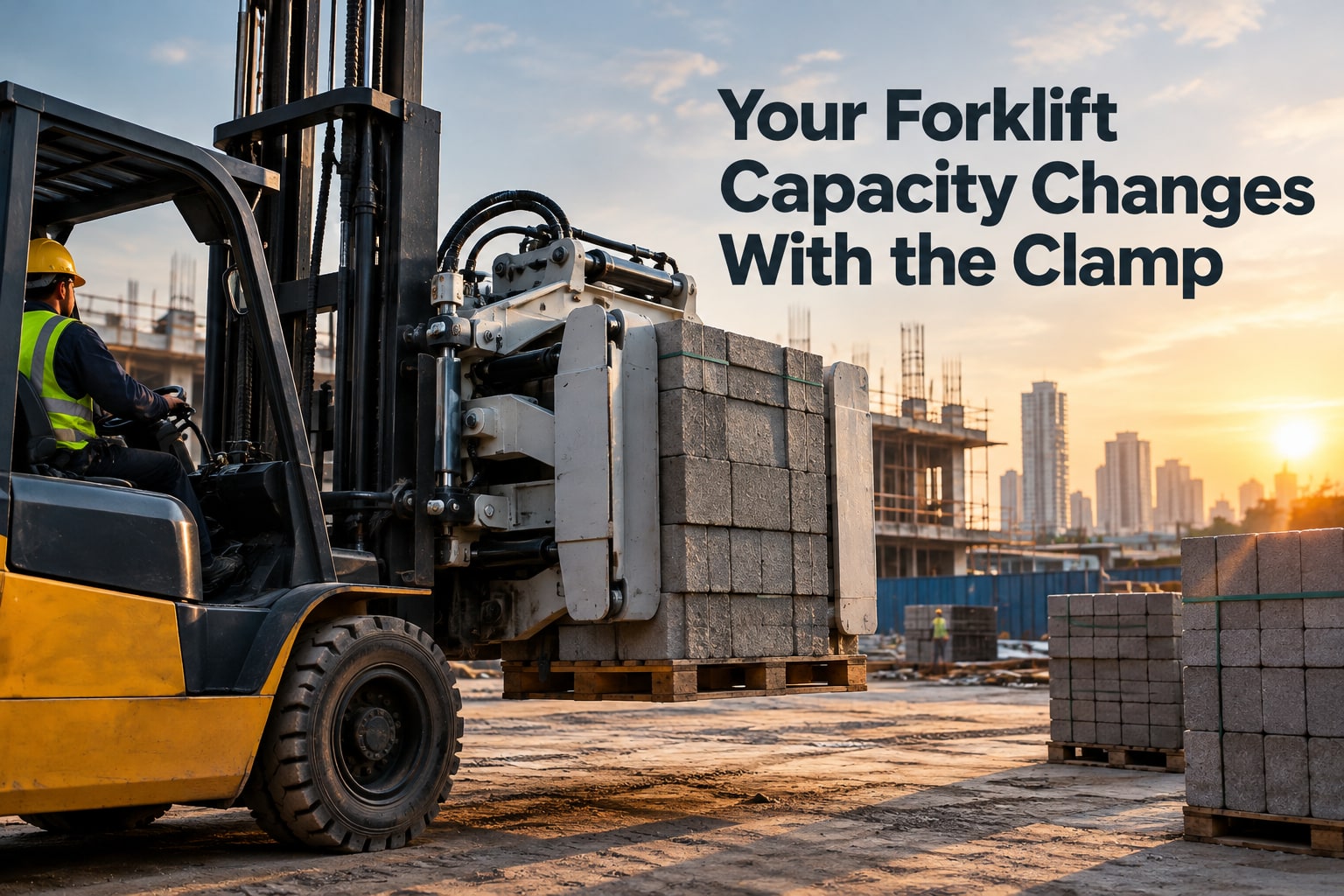
A brick block clamp lifts masonry by squeezing sound side faces with padded hydraulic arms, not by supporting the load from underneath like forks. You will learn how to judge a pack, match the clamp to a forklift, calculate usable capacity, and move the load without crushing it or allowing it to slide.
Key takeaways
- Grip sound opposing faces; never lift a pack from underneath with clamp arms.
- Match the clamp opening and rated capacity to the pack’s dimensions and weight.
- Subtract attachment weight and account for the longer load centre before lifting.
- Inspect pads, hoses, pins and pack stability before each clamp movement.
How a hydraulic brick block clamp grips and releases a pack
A hydraulic brick block clamp moves a pack by squeezing its sound, opposing faces with padded arms; it does not lift from underneath like forks. The forklift’s auxiliary hydraulic circuit drives the arms closed and open, while the attachment’s rated opening and capacity define the pack it can hold.
1. Inspect the pads, arm alignment, retaining pins, carriage hooks, welds, hoses, couplings and leaks. Remove the clamp from service if it creeps open or cannot hold a test load without abnormal leakage.
2. Confirm the pack weight against the forklift’s revised capacity at the attachment’s actual load centre. Include the clamp’s own weight and its forward projection from the fork face.
3. Approach squarely with the mast approximately vertical. Open the arms wider than the pack and keep the load within the specified minimum and maximum opening.
4. Centre the pads on the pack’s strongest vertical faces, not on loose, broken or unsupported units. A strapped or tightly bundled pack gives the arms a stable surface; one loose block does not.
5. Close the arms until the specified grip is reached. Do not guess by forcing the pads into the masonry, because excess pressure can crush blocks while insufficient pressure lets the pack slip.
6. Raise the pack only slightly and check for movement, tilting or falling units.
7. Travel with the load low and the mast tilted only as the attachment instructions require.
8. Stop level at the placement point, settle the pack, open the arms fully, and reverse straight out. This is the basic brick block clamp operation in Delhi and the safe sequence for a brick block clamp forklift attachment.
Which brick, block and paver packs can be clamped safely
A clamp can lift a masonry pack only when the pack has sound, opposing, load-bearing faces that the pads can contact without crushing or slipping. The units must form a stable shape, remain inside the attachment’s minimum and maximum opening, and stay within its rated gripping capacity.
The key to how brick block clamps move loads is controlled squeeze force, not support from underneath like forks.
A forklift for attachments in Delhi is safe only after the clamp and truck are matched. “Fits the forks” proves neither adequate hydraulic force nor capacity at the revised load centre.
| Pack condition | Safe to clamp? | Why |
|---|---|---|
| Strapped brick or concrete-block pack with parallel sides | Yes | Straps preserve the unitised shape and prevent separation |
| Stable palletised pavers with solid edge faces | Yes | The pads can grip broad, sound surfaces |
| Loose individual bricks or blocks | No | Units can slide, rotate or fall from uneven pressure |
| Broken, leaning or badly damaged pack | No | Cracks and voids can collapse under squeezing |
| Hollow blocks with fragile or unsupported side walls | Only if approved | Pads must bear on reinforced, undamaged faces |
Reject a pack if its sides are tapered, wet enough to reduce friction, obstructed by projecting units, or too narrow for full pad contact. Do not add straps to disguise a collapsing stack; rebuild it squarely and protect the edges before lifting.
Masonry with no usable opposing faces requires forks, a pallet, or another approved lifting method.
The forklift capacity and hydraulic figures to match before fitting
Match the clamp to the forklift as a combined machine, not as a loose accessory. Check the truck’s rated capacity at the attachment’s actual load centre, then subtract the clamp’s weight and account for its forward projection from the fork face. Use the revised capacity plate or an attachment-specific calculation, never the unmodified truck rating.
Before selecting construction forklift attachments in Delhi, provide the supplier with:
- Forklift make, model, rated capacity, load centre and carriage class
- Fork carriage dimensions, attachment weight, maximum and minimum jaw opening, and pad size
- Available auxiliary hydraulic pressure and flow, with the clamp’s required figures
- Pack dimensions, confirmed pack weight and the number of packs lifted per pick
- Work surface: indoor floor, paved yard or uneven construction ground
| Specification | Match against | What goes wrong if mismatched |
|---|---|---|
| Carriage class and dimensions | Clamp mounting and fork carriage | The clamp may not seat securely or may shift under load |
| Hydraulic pressure and flow | Clamp cylinder requirements | Arms may close slowly, fail to grip or release unpredictably |
| Capacity at actual load centre | Pack weight plus clamp weight and forward projection | A light-looking pack can overload the forklift |
| Jaw opening and pad size | Pack width, height and strongest vertical faces | Pads may slip, crush edges or grip off-centre |
For rental work, repeat this check for every supplied truck. “Fits the forks” does not prove safe hydraulic performance, visibility or residual capacity. Require serial-numbered capacity data and the final truck-and-attachment approval.
How load centre and clamp weight reduce usable capacity
A clamp can turn a 1,500 kg pack into an overload because it adds dead weight and pushes the pack’s centre of gravity forward. Do not use the forklift’s unmodified capacity plate after fitting it.
Use the manufacturer’s revised capacity plate or attachment calculation. For a screening calculation:
Available load capacity = [(truck rated capacity × rated load centre) − (clamp weight × clamp centre distance)] ÷ actual load centre
Measure every distance from the reference point specified by the forklift manufacturer, usually the fork face. Example: a truck rated for 2,500 kg at 500 mm has a rated moment of 1,250,000 kg-mm. A 450 kg clamp with its centre 300 mm forward consumes 135,000 kg-mm.
If the clamped pack’s centre is 700 mm forward, the calculated remaining capacity is about 1,593 kg.
- Confirm the clamp weight and centre of gravity from its data plate or manual.
- Measure the pack’s actual load centre, including the clamp’s forward projection.
- Compare the result with the attachment-specific capacity chart.
- Use the lowest limit if the chart, hydraulic system, carriage, tyres or ground conditions impose a lower rating.
The calculation is not a substitute for the revised plate: forklift manufacturers account for structural strength, mast geometry and attachment mounting details. If the same clamp moves to another rental forklift, recalculate it; “fits the forks” does not establish a safe capacity.
How to specify, inspect and operate a clamp on Delhi sites
Require more than “brick clamp, X tonnes” from a brick handling equipment supplier in Delhi. Ask for the attachment’s serial-numbered capacity chart, mounting details, carriage class, hydraulic pressure and flow requirements, operating instructions, installation record, and approval or rating for the final forklift-and-clamp combination.
Confirm pad material, spare-pad and seal availability, hose protection, lubrication points, and inspection intervals. K. S. Enterprises can be assessed on these documents rather than on nominal clamp capacity alone.
- Before each shift, inspect arm alignment, pad wear and contamination, retaining pins, carriage hooks, welds, hoses, couplings, leaks, and abnormal movement. Check that the brick or block pack is square, intact, and stable.
- Confirm the pack weight and the forklift’s revised capacity with the clamp fitted. Do not rely on the truck’s original rating.
- Approach squarely with the mast approximately vertical. Open the arms wider than the pack and centre the pads on its strongest vertical faces.
- Close the arms until the attachment’s specified grip is reached. Lift only a few centimetres and pause to confirm that the pack does not shift, rotate, or shed units.
- Travel with the load low and the mast tilted only as the attachment instructions permit. Reduce speed over potholes, ramps, and dusty uneven ground.
- Never drag a pack, pull it from a stack, brake sharply, or side-shift with light engagement. Those actions create horizontal shock and torsion.
Stop using the clamp if it creeps open, leaks abnormally, or has damaged structural parts. Clean abrasive dust from pads and pivots during inspections.
Related product
 | Forklift Attachments K. S. Enterprises is a trusted supplier of high-quality Brick Block Clamps, offering advanced material handling solutions for the construction,... View product → |
Frequently asked questions
How does a hydraulic brick block clamp move and release a pack?
The forklift’s auxiliary hydraulic circuit closes padded arms against opposing pack faces. Reversing the hydraulic control opens the arms and releases the load after it is placed securely.
Which packs can a brick block clamp grip safely?
Clamp packs with sound, opposing faces that fit within the attachment’s rated opening and capacity. Reject loose, damaged, unstable or irregular packs that cannot withstand side pressure.
What forklift figures must match before fitting a brick block clamp?
Check the attachment’s rated capacity, opening range, hydraulic pressure and oil-flow requirements against the forklift’s capacity plate and auxiliary hydraulic specifications.
How do clamp weight and load centre affect forklift capacity?
The clamp consumes part of the forklift’s rated capacity, while its weight and the pack’s position increase the load moment. Use the capacity chart for the new load centre rather than the bare-fork rating.
What should operators inspect before using a clamp on a Delhi site?
Inspect arm pads, hydraulic hoses, couplings, pins, guards and mounting points. Confirm the pack is stable, the route is clear and the operator follows the attachment and forklift instructions.