
A fast purchase depends on more than finding a Delhi listing: you need proof that the exact machine, battery, charger and configuration are ready for dispatch. By checking stock location, application fit, site dimensions and acceptance terms in the right order, you can separate same-day options from units that still require import or preparation.
Key takeaways
- Ask for Delhi-held stock and a collection or delivery time in writing.
- Send load, lift-height and aisle measurements before requesting a quotation.
- Match battery voltage, charger input and truck type to your factory.
- Define dispatch time, inspection documents and handover responsibility before payment.
Start with Delhi stock, not a generic availability claim
Start with a Delhi warehouse, showroom or rental fleet that holds the machine locally, not a dealer who promises to transfer it from another NCR city. A same-day quotation followed by collection within 24 hours is genuinely quick; next-day delivery is also practical for an urgent factory requirement.
Ask for proof before treating “electric stacker availability” as confirmed.
Send this availability request to a material handling equipment supplier for electric stacker in Delhi:
- Exact model and serial number
- Rated capacity and load centre
- Lift height, lowered mast height and fork length
- Battery voltage, ampere-hour rating, battery model and connector
- Charger input and output rating
- Delhi stock address and machine condition
- Warranty start point and dispatch date
- Pre-delivery inspection and commissioning date
A supplier who cannot identify the physical unit has not confirmed immediate delivery. An imported machine, custom mast, non-standard fork, side-shift attachment or special battery normally creates a factory-order lead time rather than a quick dispatch.
Confirm the battery and charger before booking transport. “Battery included” does not prove that the machine matches your charging supply or can complete your operating shift.
For a standard walkie or semi-electric stacker already configured for your load, lift height and battery voltage, request a written next-day delivery commitment; allow extra time when inspection, charging or commissioning must happen before handover.
Send a specification sheet before asking for a quotation
A supplier can confirm a usable machine only when your request describes both the load and the workplace. A search for “buy electric stacker in delhi” is not enough; send a specification sheet that prevents a quote for the wrong capacity, mast or battery.
1. State the maximum load in kilograms, pallet dimensions, load-centre distance and whether the load is uniform, liquid or uneven.
2. Give the required lift height, lowered mast height, fork length and minimum overhead clearance. Include the rack beam height and the lowest doorway or shutter.
3. Record the narrowest aisle, turning area, floor condition, thresholds and maximum ramp gradient. Mention wet floors, damaged concrete or outdoor travel.
4. Specify operating hours per shift, shifts per day and expected travel distance. This helps match traction performance, battery capacity and charging time to actual use.
5. Describe the charging point: available voltage, plug or socket type, charging window and whether opportunity charging is possible. Ask for the proposed battery voltage, ampere-hour rating, connector, charger input and charge duration.
6. Request the exact model, serial number, rated capacity, mast type, stock location, machine condition, warranty start point and earliest dispatch date.
7. Ask for commissioning, operator handover, service coverage, response time and replacement-machine arrangements. Confirm parts support for the controller, contactor, charger, wheels, forks and battery before comparing the quotation.
Check capacity, clearances and truck type against the factory
Confirm the stacker against a measured aisle and load, not its headline capacity. A 1,000 kg rating may apply at a specified load centre and low lift height; the allowable load falls when the pallet is deeper or the forks are raised. Check the capacity plate for your actual load centre and lift height.
Before approving an electric stacker for factories, record these site measurements and match them to the supplier’s specification:
- Maximum pallet weight and dimensions, load-centre distance, required lift height, and the residual capacity at that height
- Aisle width, turning radius, pallet-entry clearance, and the space needed to manoeuvre with the mast raised
- Door, beam, sprinkler, and ceiling clearances against the lowered and raised mast heights
- Concrete flatness, cracks, joints, ramp gradient, and any transition where a small drive wheel could lose traction
- Operating conditions, including dust, moisture, cold rooms, corrosive chemicals, outdoor exposure, and ambient temperature
- Truck type: walkie, platform-rider, or ride-on; choose the type that gives the operator adequate control and visibility in the intended area
A walkie stacker that fits a warehouse aisle can be unsafe on a ramp or slow in a loading bay. Indoor warehouse equipment is not automatically suitable for wet process areas or yard work.
Ask for the exact unit’s capacity plate, mast dimensions, wheel type, grade capability, battery voltage and ampere-hour rating, and charger input in writing. Reject a quick-delivery offer if those figures do not match the measured site.
Verify the battery, charger and support before committing
A machine can be physically in Delhi and still be unusable on your floor. Ask the electric stacker supplier in delhi for the exact unit’s serial number, battery model, voltage, ampere-hour capacity, connector, charger input and output, charging time, and dispatch date. Confirm your site has the required electrical supply and a safe charging area.
Check the cost and risk of each route before choosing:
| Option | What to verify | When it applies |
|---|---|---|
| Buy | Battery and charger included, warranty start point, scheduled maintenance, parts and repair response | You will run the stacker regularly for several years |
| Short-term rental | Battery condition, charger included, operating-hour limit, damage terms and replacement-machine process | You need immediate capacity or are testing the application |
| Longer rental | Preventive maintenance, traction-wheel and load-wheel replacement, forks, brake and emergency-stop checks | Downtime matters more than ownership |
Request pricing that includes operator handover, training, controller, contactor, charger, wheel, fork and battery-part availability. Lithium-ion removes watering work and supports opportunity charging, but it still needs the correct charger, battery-management system, thermal-event procedure and replacement terms.
Ask K. S. Enterprises to state its Delhi or NCR service coverage, response-time commitment and replacement process in writing. Compare those commitments with the cost of a stopped line, not only the purchase price. A cheap unit becomes expensive when a failed charger, worn wheel or unavailable battery leaves it parked.
Related product
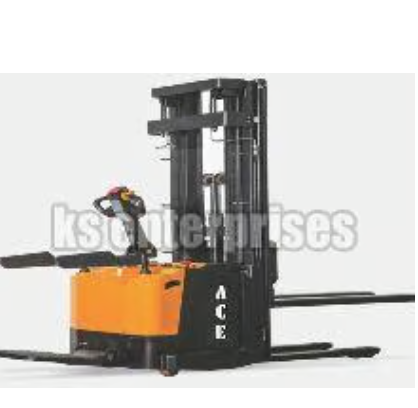 | Industrial Stackers K. S. Enterprises is a trusted supplier of high-quality Electric Stackers, offering efficient and reliable material handling solutions for... View product → |
Make the dispatch promise measurable at handover
A quote is not a dispatch promise until it identifies the exact machine and states what will happen if delivery slips. Treat electric stacker availability as a date-and-configuration commitment, not a claim that “one unit is available.”
- Ask the written quote to confirm the model, serial number, stock location, machine condition, dispatch date, rated capacity at the stated load centre, lift height, lowered mast height and fork length.
- Record the battery voltage and ampere-hour rating, battery model, connector, charger make and input voltage, charging time, and whether the charger is included.
- Require the delivery date, freight and installation charges, commissioning, operator handover, warranty start point, scheduled maintenance, spare-parts coverage and repair-response time.
- Add a remedy for extended downtime: named service coverage, target response hours, and the time allowed to provide a replacement machine.
Before acceptance, compare the machine against that document. The pre-delivery inspection must verify the serial plate, mast height, forks, battery state, charger output, emergency stop, parking brake, service brake, steering, lift and lower controls, wheels, leaks and warning devices. Run the stacker with a test load matching the quoted capacity and load centre.
Reject a substitution that changes capacity, mast, battery or charger without written approval. Sign only after the factory confirms safe operation, receives manuals and inspection records, and gets the promised warranty and service contacts.
If you plan to buy electric stacker in Delhi, make these acceptance points part of the quote rather than relying on a verbal assurance.
Frequently asked questions
How can I confirm electric stacker availability in Delhi?
Ask whether the machine is physically held in a Delhi warehouse, showroom or rental fleet. Request its model, serial number, condition and a collection or delivery time in writing.
What information should I send before requesting an electric stacker quotation?
Send required load capacity, lift height, pallet dimensions, aisle width, floor condition, operating hours, door heights and available power supply.
How do I choose the right electric stacker for a factory?
Check rated capacity at the required lift height, collapsed and raised mast clearances, turning radius, aisle width, pallet type and whether a walkie, platform or ride-on truck suits the route.
What should I verify about the battery and charger?
Confirm battery chemistry, voltage, amp-hour capacity, charging time, charger input, charging location, ventilation needs, warranty and local replacement or repair support.
How do I make a dispatch promise measurable?
Put the stock location, machine identity, inspection status, dispatch deadline, delivery or collection time, included accessories and handover documents on the quotation or order.