
An articulated forklift needs more than tyres, filters and lift chains: its centre joint, steering hydraulics, mast rollers and control sensors create additional wear points that a conventional forklift checklist can miss. By the end, you will have a part-by-part stock list, inspection schedule and identification method for ordering the correct replacement instead of a visually similar part that fails in service.
Key takeaways
- Inspect mast, hydraulics, brakes and articulation hardware on every maintenance round.
- Match replacement parts by model, serial number, dimensions and load rating.
- Stock wear items; diagnose safety-critical parts before ordering replacements.
- Compare supplier quotes with downtime, labour, freight and repeat-failure costs.
Which spare parts belong on an articulated forklift maintenance list?
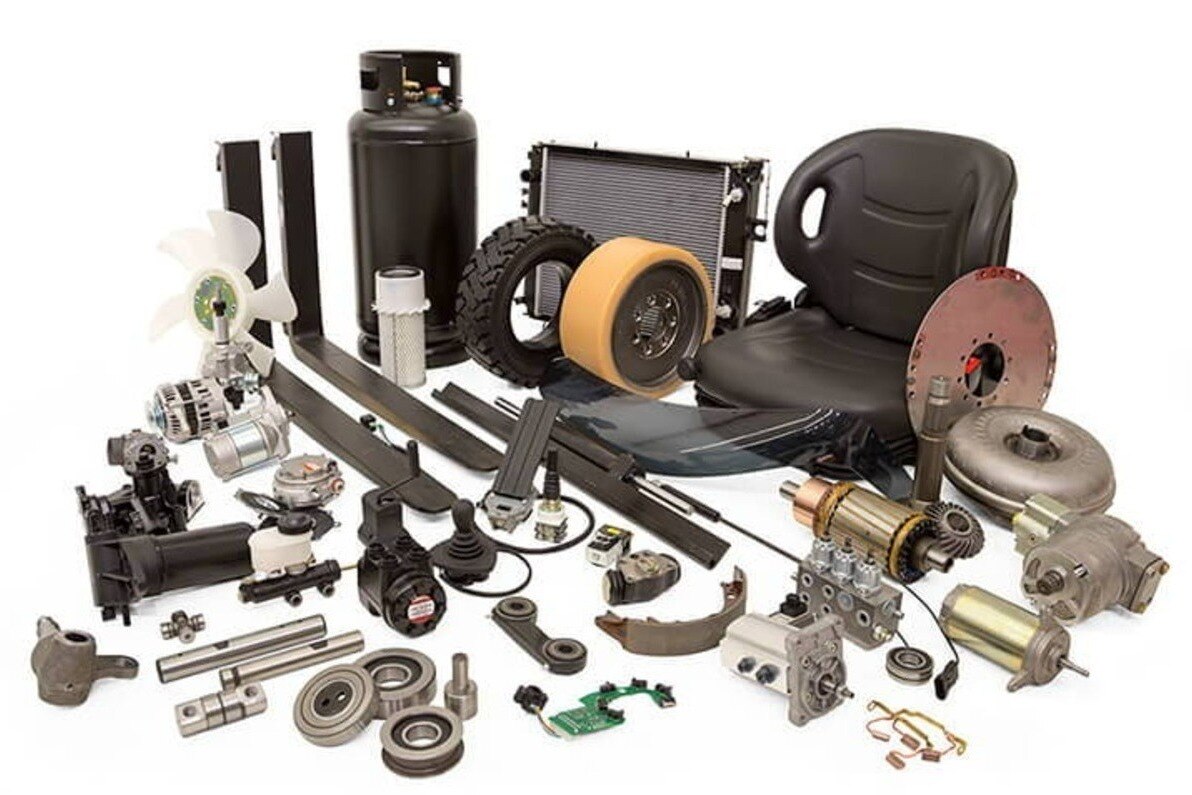
Keep these part groups on an articulated forklift maintenance list: lifting and mast components, hydraulic and steering parts, braking equipment, articulation-joint hardware, running gear, electrical controls, and battery or engine service items.
- Mast and carriage: rollers, roller bearings, tracks, carriage guides, lift chains, chain anchors, equaliser hardware, fork-retaining pins and fork hardware.
- Hydraulic system: lift and tilt hoses, hoses that flex through the centre joint, cylinders, seals, filters, fittings and return-line components.
- Steering and articulation: steering-cylinder pins, pivot pins, articulation bearings or bushes, thrust washers, seals, retaining hardware and articulation-position sensors. Joint wear creates steering wander, hose strain and mast misalignment.
- Braking and travel: brake shoes or pads, discs or drums, callipers, master-cylinder seals, parking-brake cables, traction components and drive-unit seals.
- Wheels and tyres: steer and drive tyres, rims, wheel bearings, seals and complete wheel assemblies. Articulation can scrub tyres unevenly.
- Electrical and power: switches, sensors, fuses, contactors, relays, battery connectors, chargers, battery cables, engine filters, belts, coolant hoses and starter components.
- Attachments: side-shift, clamp or other attachment hoses, seals, pins, bushes and retaining hardware.
| Part group | Stock as service wear parts | Verify or diagnose before ordering |
|---|---|---|
| Mast and carriage | Chains, anchors, hoses, filters | Rollers, bearings and cylinders |
| Centre joint | Seals and retaining hardware | Pins, bushes, bearings and sensors |
| Electrical and drive | Fuses, lamps and connectors | Contactors, control cards and traction motors |
What should you inspect daily, weekly, monthly and at service hours?
Daily inspection catches safety defects before they become spare-parts failures. OSHA requires an examination before service and after each shift for trucks used around the clock; remove a truck from service when a defect affects safety.
- Daily: Check tyres, wheels, forks, retaining hardware, lift chains, anchors, chain equalisation, mast rollers, tracks, hydraulic hoses, brakes, steering, horn, lights, warning devices, battery or engine fluids, and articulation-joint play. Look for cracks, loose fasteners, exposed wires and hose rubbing.
- Weekly: Clean and inspect the mast and carriage as one system. Check chain slack, roller surfaces, carriage guides, pivot pins, bushes, bearings, steering-cylinder pins, seals and hoses that flex through the centre joint.
- Monthly: Check wheel torque, tyre wear, brake adjustment, hydraulic-filter condition, battery connections or engine belts, sensor mounts and electrical terminals. Test the articulation-position sensor against the manufacturer’s specification.
- At scheduled service hours: Replace filters, lubricants, seals and other interval parts listed for the truck. Measure chain elongation, roller clearance, hydraulic pressure, mast alignment and articulation-joint bearing or bush wear.
Good articulated forklift maintenance treats the mast and carriage as a connected system. Replacing one worn roller without checking chain tension and alignment can cause another roller or track failure.
Articulation adds centre-joint play, hose strain and steering-cylinder misalignment that a conventional counterbalance truck does not have. The result can be steering wander, uneven tyre wear, mast misalignment and damaged hydraulic lines.
How do you identify and measure the correct replacement part?
Start with the truck, not the unreadable label. Record the make, model, full serial number, mast type, lift height, rated capacity, battery voltage or engine specification, fork dimensions and attachment model before measuring the failed part.
1. Photograph the part in place, its mounting points and every label. Copy connector markings, hydraulic port letters, chain pitch, tyre marking and any stamped number, even if only partly legible.
2. Measure the part with vernier callipers and a steel rule. Record overall length, outside diameter, bore, rod diameter, shaft diameter, thread size and pitch, bolt-hole spacing, mounting width and pin diameter. State millimetres and measure an unworn section where wear has altered the original size.
3. Match the measurement to the truck configuration. A mast roller needs its roller diameter, width, bearing size and mast position; a hose needs inside diameter, length, end fitting, angle and working-pressure rating; a wheel assembly needs tyre marking, rim size, offset and load rating.
4. Record left or right side, steer or drive position, upper or lower location and quantity fitted. Note whether the part belongs to the articulation joint, mast, attachment or chassis.
5. Send the serial number, measurements and photographs to the supplier and request written fitment confirmation. Do not substitute a visually similar sensor, chain, fork, cylinder or brake component without confirming capacity, connector, pressure and mounting compatibility.
For searches such as forklift spare parts in Delhi, this record separates a quickly stocked filter or hose from a serial-number-controlled mast roller, control card or articulation bearing. Keep the removed part until the replacement passes dimensional and functional checks.
Which parts should be stocked, diagnosed or compared by total downtime cost?
Keep fast-moving wear items on the shelf: filters, seals, fuses, lamps, hydraulic hoses, chain hardware, fork-retaining hardware and common tyres. Replace these by service interval or inspection result, not after a breakdown. Stock quantities should reflect usage rate and replenishment time.
Send these parts for diagnosis before ordering:
- Mast rollers, roller bearings, tracks, lift chains and anchors: inspect the complete mast system, because a new roller will fail again if chain tension or alignment is wrong.
- Articulation-joint bushes, bearings, pivot pins, thrust washers, seals, steering-cylinder pins and position sensors: measure joint play and check hose strain before selecting parts.
- Control cards, traction motors, proprietary sensors, complete hydraulic cylinders, contactors and brake assemblies: test the failed component and its wiring first.
Compare the part against the cost of lost production, recovery labour and repeat failure:
| Option | What it means | When it applies |
|---|---|---|
| OEM | Exact maker specification, with documented fitment | Capacity, braking, steering, lifting or electronic safety functions |
| Approved aftermarket | Verified dimensions, rating and model compatibility | Standard wear parts where quality and warranty support are documented |
| Generic | Lowest initial price, uncertain fit or rating | Only after dimensions, load rating and safety impact are proven |
A cheaper part is expensive if it stops the truck twice. Ordering by appearance, forklift model alone, or an unreadable old part number causes errors; give the supplier the serial number, mast configuration, capacity, voltage, tyre position and attachment details. For forklift spare parts in Delhi, compare total downtime cost, not delivery price alone.
What should you ask an articulated forklift parts supplier in Delhi?
A search for an articulated forklift for spare parts in delhi should end with questions, not just a delivery promise. Ask the articulated forklift supplier in delhi to prove fitment, installation support and after-sales responsibility before you compare prices.
1. Can you verify the part against the truck’s make, model, serial number, mast type, lift height, capacity, battery voltage or engine specification, fork dimensions and attachment model? Ask for written confirmation. Mast rollers, chains, cylinders, sensors and steering parts can change across serial ranges.
2. If the original part is unavailable, what approved alternative will you provide? Require its dimensions, load rating, material specification and compatibility statement. Do not accept a visually similar brake, steering, lifting or electronic safety part without evidence that it preserves safe operation.
3. Who handles installation, calibration and testing? Confirm support for mast alignment, chain equalisation, hydraulic pressure, steering-centre sensors, articulation-position sensors and attachment settings. Ask what inspection or test record you receive after fitting.
4. What happens if the part fails or the truck develops a related fault? Get the warranty period, exclusions, claim documents, failure-analysis process and response time in writing. For a modified truck or attachment, request manufacturer or qualified-engineer approval and updated capacity data.
K. S. Enterprises can be useful to compare against when you need one contact for model-specific parts, attachment fitment and service coordination rather than separate delivery-only vendors.
Related product
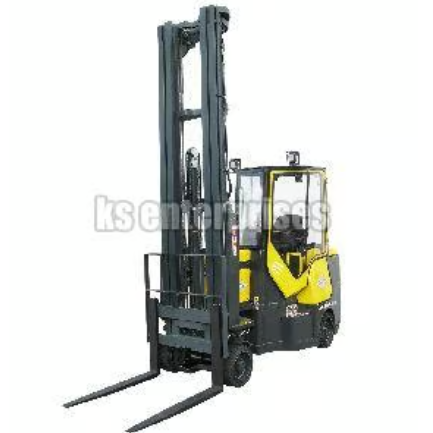 | Forklifts K. S. Enterprises is a trusted supplier of premium-quality Articulated Forklifts, offering advanced material handling solutions designed to improve... View product → |
Frequently asked questions
Which spare parts belong on an articulated forklift maintenance list?
List lifting and mast components, hydraulic and steering parts, braking equipment, articulation-joint hardware, running gear, electrical controls, and battery or engine service items.
What should you inspect daily, weekly, monthly and at service hours?
Check safety controls, leaks, tyres or wheels, forks, chains, brakes, steering and warning devices daily. Add lubrication, fastener checks, battery or engine service, hydraulic inspection and manufacturer-scheduled replacements at weekly, monthly and hour-based intervals.
How do you identify and measure the correct replacement part?
Give the supplier the forklift make, model, serial number, part number, photographs, dimensions, thread or connector details, load rating and the failed part’s application.
Which forklift parts should you stock or diagnose first?
Stock predictable wear items and filters when a failure would stop operations. Diagnose hydraulic valves, controllers, sensors, motors and steering components before replacing them because symptoms can overlap.
What should you ask an articulated forklift parts supplier in Delhi?
Ask whether the part matches your model and serial range, whether it is genuine or aftermarket, what warranty and lead time apply, and whether installation or technical support is available.