
A semi-electric stacker can lower lifting effort without offering the travel performance of a fully electric truck, so the wrong specification quickly becomes a safety and productivity problem. You will be able to match capacity and lift height, inspect and operate the truck safely, plan semi-electric stacker maintenance, and judge whether a Delhi repair service has completed the job properly.
Key takeaways
- Choose capacity, load centre and lift height together.
- Use a powered stacker when pushing becomes tiring or unsafe.
- Check forks, chains, brakes, battery and leaks before each shift.
- Give the repair technician the model, fault and battery details.
What a Semi-Electric Stacker Does—and When It Is the Wrong Choice
A semi-electric stacker uses battery power to raise and lower its forks; the operator still pushes and steers it unless the model also has powered travel. That split makes it useful for short pallet movements and occasional stacking, but tiring or unsafe work exposes its limits.
| Truck type | Powered function | Manual effort | Best fit |
|---|---|---|---|
| Manual stacker | None | Push, steer and lift | Light, infrequent handling |
| Semi-electric stacker | Electric lift; travel depends on model | Push and steer on lift-only models | Short indoor moves and moderate stacking |
| Fully electric stacker | Lift and travel | Steering and controls | Repeated movement over longer distances |
| Forklift | Lift and travel | Steering and controls | Heavier loads, ramps, outdoor work and higher productivity |
Check the data plate before choosing. A semi electric stacker in Delhi is not one standard configuration, so confirm travel type, rated capacity, load centre, lift height, mast type and battery voltage. A unit’s headline capacity can fall at greater lift heights or load centres.
Choose another truck when:
- You move pallets long distances throughout each shift; powered travel reduces pushing effort and fatigue.
- The route includes ramps, uneven floors or outdoor surfaces; use equipment designed for traction, ground clearance and stability there.
- You lift continuously, run multiple shifts or need faster travel; a fully electric stacker or forklift is better suited.
- Loads exceed the stacker’s nameplate capacity, or you need an operator platform and higher travel speed.
Use the manufacturer service manual and data plate for compatible forks, chains, batteries and chargers. Similar dimensions do not make those parts interchangeable.
Match Capacity, Load Centre and Lift Height Before You Buy or Hire
A 1,000 kg headline rating does not mean the truck can lift 1,000 kg to every height. Capacity falls when the load centre moves forward, the mast is raised, or an attachment is fitted. Read the capacity plate at the required lift height and load centre, not the largest number in the brochure.
1. Weigh the heaviest loaded pallet, including the pallet itself, and measure the load centre from the fork face to the load’s centre of gravity.
2. Measure the rack beam height, then add clearance for the pallet and forks. Select a mast whose maximum lift height clears that beam, while confirming its residual capacity at that height.
3. Measure pallet entry openings, fork length, truck width, turning radius and the narrowest aisle. Check floor slopes, joints and uneven areas; a manually pushed truck becomes difficult to control on gradients.
4. Confirm whether travel is manual or powered, then match battery capacity to the number of lifts and operating hours. Do not assume a larger battery fits without affecting weight, compartment clearance or capacity.
5. Recheck the plate after changing fork length, mast, battery or attachment. Stop the purchase or hire if the supplier cannot provide the revised capacity and stability information.
A purchase or hire brief for a semi electric stacker in Delhi should state rated capacity, load centre, lift height, mast type, fork dimensions, travel type and aisle width. If the actual load exceeds the plate rating at its working height, choose a higher-capacity truck or change the handling method.
Operate and Inspect the Stacker Safely in a Pedestrian Warehouse
Before each shift, examine the semi-electric stacker and remove it from service if any safety defect appears. A daily inspection is required, or after each shift when the truck operates around the clock; only authorised personnel may repair it.
1. Check the data plate against the planned pallet. Confirm load weight, load centre, lift height and attachment match the rated capacity. Do not lift a damaged, unstable or overhanging load.
2. Inspect both forks, fork-retaining parts, mast rails, lift chains, hydraulic hoses and fittings. Look for cracks, bent forks, stretched or corroded chains, leaks and loose hardware.
3. Test the wheels, brakes, steering or tiller controls, horn, emergency-reverse button and lift and lower controls in a clear area. Check the battery connector, charger lead, warning labels and guards for damage.
4. Walk the route before moving goods. Remove shrink wrap and debris, mark blind corners, keep pedestrians out of the operating lane and agree who has priority at crossings. Sound the horn at doorways and blind intersections.
5. Travel with the forks low, the load centred and the mast stable. Slow down before turns, keep the load below eye level when visibility permits, and stop if pedestrians enter the exclusion area. Never carry passengers or stand beneath raised forks.
6. Charge lead-acid batteries only in the designated ventilated area. Prohibit smoking, flames and sparks, and keep electrolyte-flushing and spill-neutralising facilities ready.
Record defects and report them immediately. Do not return the stacker to work until the repair and post-repair safety check are complete.
Semi-Electric Stacker Maintenance: Intervals, Battery Care and Fault Diagnosis
Good semi electric stacker maintenance starts with a daily inspection, followed by scheduled lubrication, chain checks, hydraulic-fluid and filter checks, and fastener checks at the manufacturer’s intervals. Increase inspection frequency in dusty, wet or heavy-duty warehouse conditions.
Check these items before use:
- Forks, fork-retaining parts, mast and lift chains
- Hydraulic hoses, cylinders and leaks
- Wheels, brakes, tiller controls and emergency reverse button
- Horn, battery connector, charger lead and warning labels
Remove the truck from service for cracked forks, leaking hydraulics or failed emergency controls.
Battery care depends on chemistry:
| Battery chemistry | Routine care | Fault clues |
|---|---|---|
| Flooded lead-acid | Check electrolyte level and add water only as the battery maker specifies; clean terminals and charge in ventilation | Slow lifting, heat, low voltage or exposed plates |
| Lithium-ion | Use a compatible charger; inspect BMS warnings, connectors and pack damage | Charging lockout, fault code, rapid charge loss or heat |
Investigate slow or uneven lifting with a controlled test, not a battery swap. Record load, lift height, battery state of charge and fault codes, then check hydraulic level, contamination, filter restriction, leaks, seals, valve movement, air, chain synchronisation, mast alignment and bent rails.
For repeated faults, document floor gradient, wheel condition, impact damage and duty cycle against rated capacity. A service agreement should state response time, travel and diagnostic charges, labour, parts and battery warranties, critical-parts availability, load testing and post-repair safety inspection.
How to Specify Forklift Service and Repair in Delhi
A technician cannot safely diagnose “a stacker” from that description alone. For semi electric stacker forklift service and repair in Delhi, send a photo of the data plate, fault codes, travel type, rated capacity, lift height, mast configuration, load centre, battery voltage and ampere-hour rating, charger model, and the manufacturer’s service manual.
1. Describe the failure precisely: slow lifting, uncontrolled lowering, charging interruption, brake noise, steering resistance, or intermittent travel. Record the battery’s state of charge, load and duty cycle, floor gradient, wheel condition, mast alignment, impact damage, and whether the truck exceeded its rated height or capacity. This evidence prevents repeated replacement of a symptom part.
2. Put these terms in the service agreement: emergency response time; preventive-maintenance frequency; travel and diagnostic charges; labour warranty; parts warranty; battery warranty; critical-parts availability; and whether load testing and a post-repair safety inspection are included. “On-site service available” does not define uptime or acceptance.
3. Require testing before signing off. The technician must demonstrate unloaded and rated-load lifting and lowering, braking, travel or push operation, emergency reverse, horn, limit switches, and charger interlock where fitted. Check the job sheet for measured results, replaced-part numbers, fault codes, and the next service date.
For stacker repair in Delhi, identify battery chemistry in the quotation. Flooded lead-acid batteries need maker-specified electrolyte checks and watering; lithium-ion packs need compatible chargers, battery-management-system checks, and thermal-safety provisions. K. S. Enterprises can use these details to scope forklift service and repair accurately rather than quote against the word “stacker” alone.
Related product
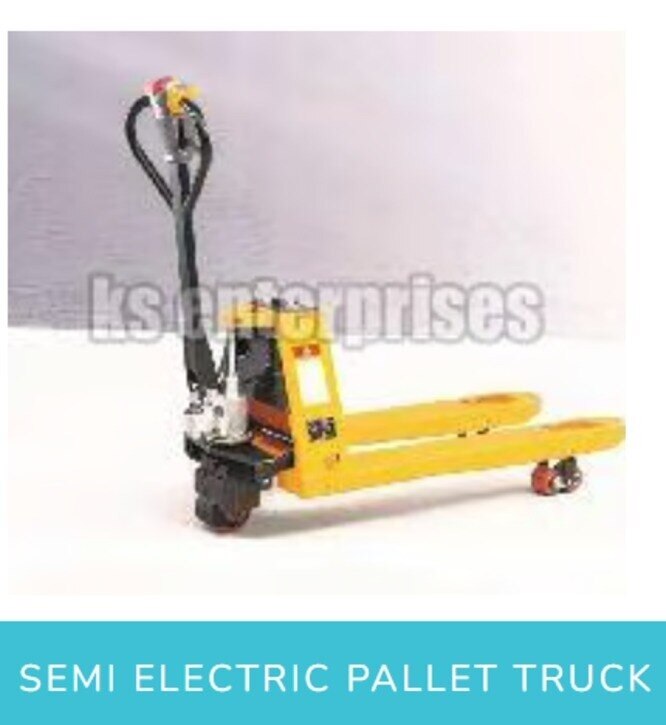
 | Industrial Stackers K. S. Enterprises is a trusted supplier of premium-quality Semi Electric Stackers, offering efficient and economical material handling solutions for... View product → |
Frequently asked questions
When is a semi-electric stacker the wrong choice?
It is the wrong choice when operators must push long distances, work on ramps, stack continuously or move heavy loads in congested pedestrian areas. Choose powered travel when manual pushing creates fatigue or control risks.
What specifications must you match before buying or hiring a stacker?
Match rated capacity, load centre and maximum lift height to the pallet and racking. Confirm the capacity at the intended lift height, not only the headline rating.
What should you inspect before operating a semi-electric stacker?
Check the forks, mast, chains, wheels, brakes, emergency stop, battery connector, cables, hydraulic leaks and warning labels. Test lifting, lowering and travel controls in a clear area.
What information should you provide for forklift service and repair in Delhi?
Provide the equipment make and model, serial number, battery voltage, operating hours, fault symptoms, warning codes and the time the problem began. Share photographs of damaged parts and the charger when relevant.