
A hand pallet truck must match the load, pallet, floor and travel route—not just the weight printed on its capacity plate. By the end, you will be able to compare truck configurations, identify when manual handling is unsuitable, inspect a unit before purchase and test whether its parts support is practical for a Delhi operation.
Key takeaways
- Rate the truck above your heaviest pallet at the stated 600 mm load centre.
- Match fork length, width and wheel material to your pallets and floor.
- Choose powered movement when distance, gradients or load frequency strain manual handling.
- Confirm local stock and lead times for hand pallet truck parts before buying.
Match capacity, load centre and fork dimensions to the job
Start with the heaviest complete pallet, not the truck’s advertised maximum. Choose a hand pallet truck whose rated capacity exceeds that load and confirm the rating applies at the stated load centre, commonly 600 mm.
A pallet within the weight limit can still overload the forks when its centre of gravity sits farther forward, increasing bending force and reducing safe usable capacity.
Measure the load, pallet and storage route before selecting the truck:
- Actual loaded weight, including packaging
- Load centre, measured from the fork face to the load’s centre of gravity
- Overall fork width and each fork’s width
- Fork length and clearance between the fork legs
- Lowered fork height and the gap beneath the pallet
- Pallet entry openings, pocket spacing and bottom-board layout
- Turning space, steering radius and floor clearance
A nominal 1,150 mm fork will not suit every pallet, especially with narrow-side entry or blocked bottom boards. Forks that are too long can strike the next pallet; forks that are too short leave the load unstable.
Check the route separately from capacity. Ramps, dock levellers, uneven concrete and outdoor yards can make a manually propelled truck difficult to stop or steer even with a permitted load.
A quick-lift model reduces pump strokes for light, frequent moves, but verify its separate quick-lift load limit; the full rated capacity does not automatically apply during that function.
Choose the configuration that fits the pallet and floor
A pallet’s entry height and bottom-board layout decide the truck more reliably than capacity alone. Check fork-pocket spacing, opening height, clearance beneath the load and the turning space available on your route.
| Option | Check before choosing | Best fit |
|---|---|---|
| Standard | Normal pallet entry height and sound, level floors | General warehouse movement |
| Low-profile | Unusually low fork openings; reduced ground clearance | Special low-entry pallets, not broken boards or uneven dock plates |
| Wide-fork | Pallet width and pocket spacing accept wider forks | Broad or unstable loads that need more support |
| Short-fork | Forks fit without striking the opposite board or racking | Small pallets, narrow aisles and congested loading bays |
| Long-fork | Pallet length and turning radius provide clearance | Long pallets or two pallets moved together, where the route allows it |
| Galvanised | Exposure to rain or occasional moisture; not continuous washdown | Outdoor movement and damp areas |
| Stainless-steel | Frequent washing, chemicals or corrosive production areas | Food, pharmaceutical and wet-process environments |
A short-fork hand pallet truck that fits the aisle can still leave part of a pallet unsupported. Long forks can catch a neighbouring pallet during a turn, while low-profile forks can bottom out on a dock leveller or damaged floor.
Walk the actual route before buying. Include ramps, uneven concrete, dust, rain exposure, cold rooms and loading-bay thresholds; manual control becomes difficult on inclines even when the load is within capacity. Record the truck’s model and serial number because pump seals, wheel bores, axles and release valves are not interchangeable simply because capacity matches.
Let the route decide between manual and powered movement
A hand pallet truck is suitable for short, floor-level moves on firm, reasonably smooth concrete where you can keep the load under control without climbing a slope. It works well for staging pallets beside a packing line, moving stock between nearby bays, and positioning loads in open floor storage.
It cannot stack pallets or place them in racks.
| Equipment | Route and task | Choose it when |
|---|---|---|
| Hand pallet truck | Short travel on level floors | Trips are occasional, aisles are clear, and the operator can push and steer safely |
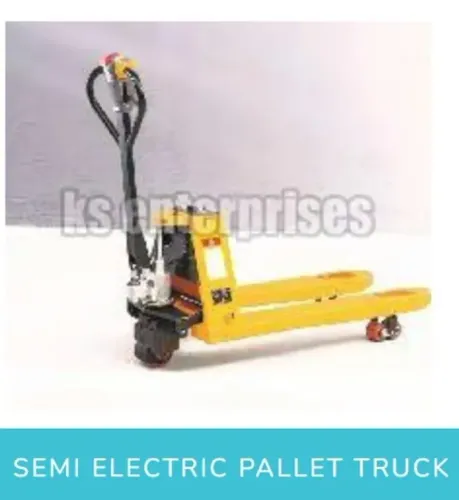
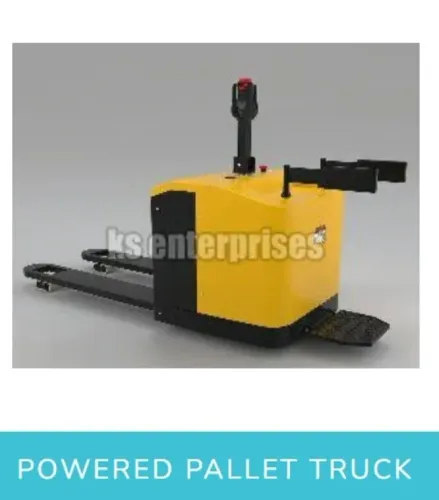
| Powered pallet truck | Repeated travel, longer distances, ramps or dock levellers | Manual pushing becomes tiring or braking and control matter on the route |
| Forklift | Lifting, stacking, truck loading and rack placement | The job needs elevated handling, outdoor travel or greater ground clearance |
Do not approve a hand pallet truck because the load falls below its rated capacity. On an incline, a loaded manual truck can become difficult to start, stop or turn even within that rating; uneven concrete, rain at a loading bay and a dock leveller increase the risk.
Before ordering, walk the complete route with a loaded pallet. Measure slopes, turning points and travel distance, then confirm the required lift height. Record the truck’s model and serial number for any forklift spare parts in Delhi: equal capacity does not guarantee interchangeable pumps, seals or wheels.
Inspect the truck’s controls, wheels and structure before buying
A five-minute inspection can expose a truck that looks cheap but will quickly consume repair time. Test it unloaded, then repeat the operating checks with a representative load.
1. Pull the handle through its full steering range. It should move without binding, excessive side play or a cracked weld. Operate the lift, neutral and lowering positions; the lever must return cleanly, the forks must rise evenly, and lowering must remain controlled rather than dropping.
2. Pump the handle repeatedly and inspect the hydraulic unit for oil seepage around the ram, hose connections and pump body. With the forks raised, leave the truck stationary for several minutes; sinking indicates an internal leak or worn seal.
3. Examine each steering and load wheel for flat spots, splits and uneven wear. Spin them to detect rough bearings, then check axle pins, bushes and fasteners for looseness. Wheels that wobble will increase pushing effort and damage warehouse floors.
4. Sight along both forks and reject bends, twisted tips, deep rust or cracked welds. Inspect the frame, fork links, drawbar and handle-return mechanism because a failed structural or control part can immobilise the truck.
5. Ask for the exact model and serial number, a parts cross-reference and the preventive-maintenance schedule. Hand pallet truck parts are not interchangeable merely because two trucks share a capacity rating; pump dimensions, seals, bores and axles can differ.
Before paying, price hydraulic repair kits, lowering valves, wheels and a complete pump unit. Confirm local stock and replenishment time, not merely “available”; that evidence shows whether the truck will remain economical to maintain.
Test parts availability before choosing your Delhi supplier
Verify support against the truck’s model and serial number, not just its capacity. A hand pallet truck for forklift spare parts support in Delhi needs an identifiable parts cross-reference, repair expertise and a response time you can test before payment.
| Check | Evidence to request | Warning sign |
|---|---|---|
| Parts identity | Exploded diagram or OEM numbers for hydraulic seals, pump assembly, lowering valve, wheels, axle pins, bushings, drawbar, fork links and handle-return parts | “Universal” parts with no dimensions |
| Local stock | Current stock status and lead time for wheels, hydraulic repair kits, lowering valves and complete pump units | “Available” without a date |
| Repair capability | Named technician, service procedure, warranty exclusions and preventive-maintenance interval | Sales staff cannot explain the repair |
| Response arrangement | Delhi dispatch or visit window, escalation contact and after-hours process | Verbal promise only |
Ask the pallet truck supplier in Delhi to record pump-body dimensions, seal sizes, wheel-bore diameter, axle length, fork spacing and release-valve type. Similar capacity or brand does not prove interchangeability; these details prevent a wrong order for forklift spare parts in Delhi.
- Request the supplied truck’s model plate photograph and parts manual.
- Ask whether wheels, seals or hydraulic cartridges match equipment already in your fleet.
- Place a test enquiry for one wheel and one hydraulic kit, then measure the promised acknowledgement and delivery time.
K. S. Enterprises should be assessed on this evidence too: a quotation for the complete truck alone proves neither parts support nor repair readiness.
Related product
 | Pallet Trucks K. S. Enterprises is a trusted supplier of premium-quality Hand Pallet Trucks, offering reliable and cost-effective material handling solutions for... View product → |
Frequently asked questions
How do I match a hand pallet truck to my load?
Start with the heaviest complete pallet. Choose a rated capacity above that weight and confirm the rating at the stated load centre, commonly 600 mm.
Which fork dimensions should I check before buying?
Measure the pallet entry openings, fork length and required outside fork width. The forks must enter fully without contacting the pallet blocks or load.
When should I choose a powered pallet truck instead of a manual one?
Choose powered movement when the route is long, includes gradients, involves frequent trips or makes pushing a loaded manual truck physically demanding.
What parts support should a Delhi supplier provide?
Ask which hand pallet truck parts are locally stocked, including wheels, seals, hydraulic components, handle assemblies and control parts, and request expected lead times for unavailable items.