
A bale clamp earns its place only when compatible bales move often enough to repay the attachment, installation, capacity loss and maintenance. By measuring your bale flow, comparing competing attachments and testing the clamp on your actual forklift and route, you can calculate whether buying, renting or staying with standard forks is the sounder decision.
Key takeaways
- Compare pallet, labour, damage, and attachment costs per shift.
- Match clamp capacity and pad design to bale material and density.
- Confirm forklift residual capacity, hydraulic flow, and attachment approval.
- Demand load charts, installation records, warranty terms, and service support.
When does a bale clamp create a measurable advantage?
A forklift bale clamp is worth buying for material handling equipment in Delhi when palletless handling removes more work and loss than the clamp adds. Count suitable bales per shift, pallet purchases and repairs, loading steps, labour minutes, damage, and forklift utilisation. Low volume or mixed loads rarely justify a dedicated attachment.
The strongest case is dense, uniform paper, cotton, textile-fibre, or recycled-plastic bales with surfaces that tolerate clamp pads. Soft, wet, irregular, under-compressed, or damaged bales can slip or deform, turning a faster-looking move into product loss.
Palletless storage also needs stable dimensions, adequate floor loading, and stacking clearances; a clamp does not make unsafe stacks safe.
Run a live trial before buying a forklift bale clamp for warehouses. Use normal full and partial bales, dust or moisture found on site, usual stack heights, turns, braking, and truck-to-rack placement. Record minutes per move, slips, bale damage, operator interventions, eliminated pallets, and truck idle time.
Compare those results with standard forks and pallets across enough shifts to expose rehandling. If the attachment does not produce a repeatable gain in handling time, damage rate, or equipment utilisation, continuing with forks is the measurable choice.
Which attachment matches your bale type and handling method?
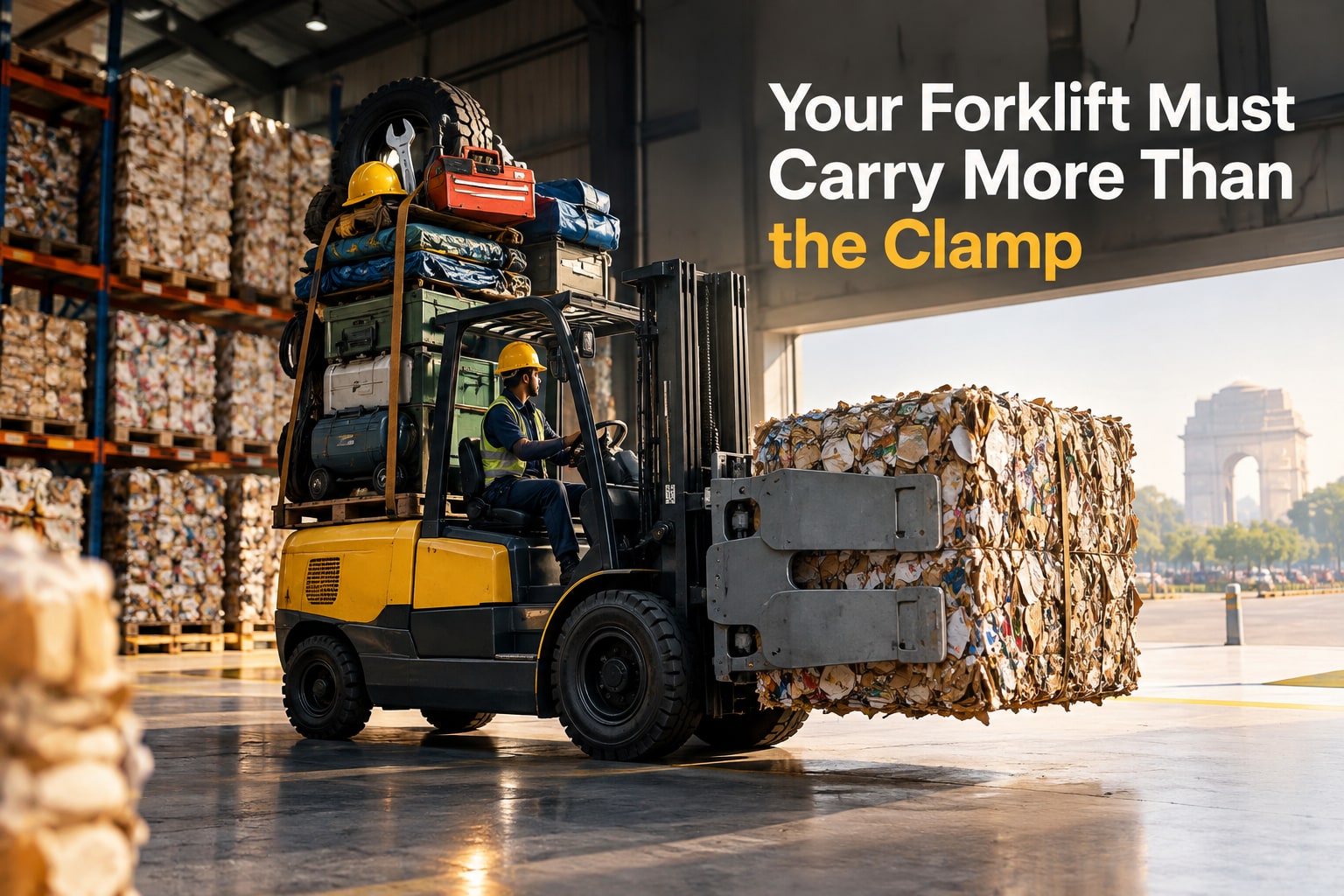
Choose the attachment by bale construction, not by forklift capacity alone. Treat bale clamp material handling equipment as a matched system: the bale’s weight, width, height, density, wrapping, moisture and surface condition determine whether its jaws can grip without crushing or slipping.
| Option | Best match | Main trade-off |
|---|---|---|
| Bale clamp | Uniform, compressible wrapped or unwrapped bales handled singly or in groups | Fast palletless handling, but excessive pressure marks bales and low pressure allows sliding |
| Standard forks | Rigid, palletised bales or loads with a stable base | Low attachment cost, but requires pallets and cannot safely grip loose bales |
| Bale spears | Dense, tough bales where puncture is acceptable | Secure penetration, but damages wrapping and does not suit fragile or wet material |
| Push-pull attachment | Unitised bales on slip sheets | Removes pallets, but needs compatible slip sheets and extra positioning |
| Paper-roll or carton clamp | Cylindrical rolls or rigid cartons, not ordinary fibrous bales | Correct contact geometry; wrong jaws can crush or eject a bale |
| Dedicated bale handler | High-volume work with repeated bale sizes, long travel or specialised loading | Best control and throughput, but adds capital, space and maintenance |
Select a clamp only when its jaw opening covers the smallest and largest bale, its pads suit the wrapping, and its pressure range holds full and partial bales without deformation. Wet, dusty or uneven surfaces demand more grip; that does not justify simply increasing pressure.
For palletless storage, check bale compression consistency, floor loading, stack height and access to adjacent stacks. If bales vary widely or require frequent truck-to-rack placement, trial a dedicated handler before committing to a clamp.
Can your forklift safely carry and operate the selected clamp?
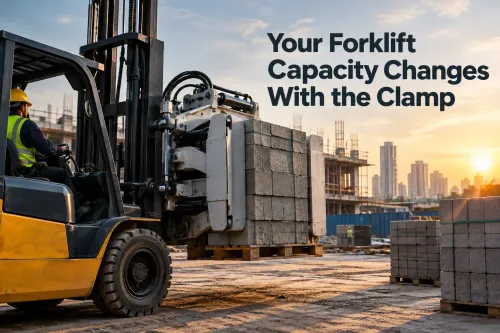
The forklift’s original capacity plate is not enough: adding a clamp changes both truck weight and load centre, so available capacity falls. Proceed only when the combined truck-and-attachment rating appears on a revised or approved data plate or load chart for the intended lift height and load centre.
Ask the supplier to document:
- Clamp weight, carriage class and carriage width, plus hook-on or sideshifting fit.
- Jaw opening, pad material and configuration, maximum operating pressure, and permissible bale mass, width, height and density.
- The forklift’s auxiliary hydraulic pressure and flow requirement, and whether the mast, hoses and overhead clearance accommodate the attachment.
- Residual capacity after installation, tested with your heaviest and largest bale.
- Installation scope, guarding, commissioning method, operator instructions, warranty exclusions and breakdown response time.
- An acceptance trial using full and partial bales, actual wet or dusty surfaces, normal stack heights, emergency braking, turning, and truck-to-truck or truck-to-rack placement.
Do not accept an empty-yard demonstration as proof. Record handling time and every slip, damage event or operator intervention during the trial. Excessive pressure damages the bale; insufficient pressure lets it slide during braking or mast tilt. Check route clearance at blind intersections.
Carry loads low, control speed, and use reverse travel when the load blocks forward visibility.
How do you calculate the forklift bale clamp cost benefit in Delhi?
Use annual cost per handled bale, not the attachment quotation, to calculate value. Include the clamp, installation, hydraulic modifications, approved capacity-plate changes, pads, seals, inspections, financing, downtime, and expected equipment utilisation. Against that, count avoided pallets, pallet repairs, loading labour, rehandling, product damage, and rental charges.
A useful forklift bale clamp cost benefit in Delhi calculation comes from a controlled field trial. Use the same forklift model, mast, operators, route, bale mix, and stack heights proposed for production. Record full and partial bales, wet or dusty conditions, turning, emergency braking, truck placement, and rack placement.
Track these figures during the trial:
- Bales handled per shift and handling frequency
- Average cycle time, operator interventions, slips, and rehandling
- Damaged or deformed bales and the rupee value of lost material
- Pallets eliminated, pallet-loading minutes removed, and pallet repairs avoided
- Rental cost for the trial and the clamp’s projected annual maintenance and downtime
Calculate payback as total installed purchase cost divided by annual net savings. Compare that result with continued pallet handling and rental over the same period. A rental trial remains the safer choice when bale geometry, throughput, or damage rates are uncertain.
Buy only when measured savings survive normal operating conditions. A cheap clamp that slips on under-compressed bales, needs frequent seal replacement, or lacks Delhi parts support can cost more per handled bale than standard forks or rental.
What should you demand from a forklift bale clamp supplier in Delhi before buying?
Do not accept a capacity figure without its conditions. Ask the forklift bale clamp supplier in Delhi to state the tested bale mass, width, height, density, wrapping, allowable pressure, pad configuration and residual forklift capacity in the quotation.
- Confirm carriage class and width, hook-on or sideshifting design, auxiliary hydraulic pressure and flow, installation scope, and the revised truck-and-attachment load chart or data plate.
- Require written commissioning instructions covering clamping pressure, load centre, inspection points, operator training and warranty exclusions.
- Put the breakdown response time, spare-parts availability and maintenance schedule in the purchase order, not in a verbal promise.
Demand this evidence before payment:
| Requirement | Written proof | What to reject |
|---|---|---|
| Capacity | Tested bale dimensions, mass and pressure | “Heavy duty” with no test conditions |
| Compatibility | Carriage, hydraulics, mast clearance and residual capacity | Original forklift rating reused unchanged |
| Acceptance test | Trial criteria and pass/fail limits | Empty-yard demonstration only |
| Service | Response time, warranty exclusions and parts route | Warranty with no exclusions or response period |
Run the acceptance test on your forklift, route and bale mix. Include full and partial bales, wet or dusty surfaces, normal stack heights, emergency braking, turning and truck-to-truck or truck-to-rack placement. Record handling time, slips, bale damage and operator interventions.
K. S. Enterprises should provide these confirmations in writing if it is quoting the attachment; compare its documents with another supplier before signing. A rental trial is safer when geometry or damage rates remain uncertain.
Related product
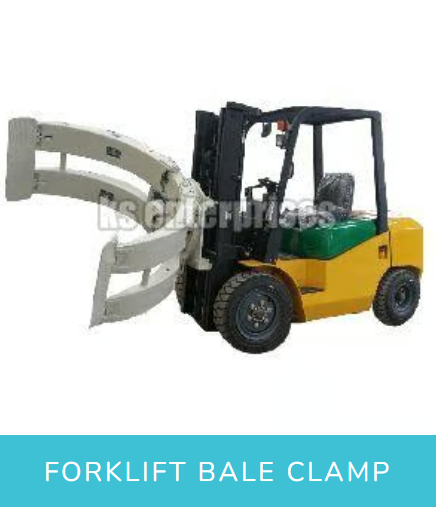 | Forklift Attachments Heavy-Duty Material Handling Solution by K. S. Enterprises K. S. View product → |
Frequently asked questions
When does a forklift bale clamp create a measurable advantage?
A bale clamp creates measurable value when palletless handling reduces pallet purchases, loading steps, labour time, product damage, or forklift travel across enough bales per shift to cover attachment and maintenance costs.
Which attachment matches your bale type and handling method?
Choose clamp arm length, opening range, pad shape, and rated capacity for the bale material, dimensions, density, wrapping, and whether you handle one bale or multiple bales at once.
Can your forklift safely carry and operate the selected clamp?
Check the forklift's residual capacity at the actual lift height, attachment weight, load centre, hydraulic flow and pressure, mast rating, and manufacturer's approval before installation.
How do you calculate the forklift bale clamp cost benefit in Delhi?
Compare annual pallet, labour, damage, fuel, rental, maintenance, and downtime savings with the clamp purchase, installation, inspection, repair, and financing costs.
What should you demand from a forklift bale clamp supplier in Delhi before buying?
Request a rated load chart, attachment dimensions, hydraulic requirements, compatibility confirmation, installation documentation, warranty terms, spare-parts availability, operator training, and service response details.