
A quoted capacity or narrow-aisle label does not prove that a truck will lift your pallet safely or fit your warehouse. By checking the specification sheet, aisle geometry, facility limits, residual-capacity chart and included equipment, you can compare articulated trucks on operating evidence rather than catalogue claims.
Key takeaways
- Record residual capacity at your lift height, load centre and attachment configuration.
- Measure rack clearance, turning space and obstruction points before selecting an aisle width.
- Check tyres, forks and attachments because each can change stability and usable capacity.
- Demand the load chart, service scope, delivery timeline and warranty terms in writing.
Which specifications define an articulated forklift truck?
A buyer seeking an articulated forklift truck for specifications in Delhi should record usable capacity, not the largest number in the model name.
The sheet must state rated load, load-centre distance (500 or 600 mm), maximum lift height, residual capacity at the required height, mast-collapsed height, overall length and width, wheelbase, turning radius and manufacturer-stated minimum aisle width.
- Mast type and stages; fork length, section, heel condition and attachment interface
- Electric, diesel or other powertrain; for electric trucks, battery voltage, amp-hour capacity, charger rating, charging time and expected operating hours
- Tyre type, ground clearance, maximum gradient, permissible floor unevenness, ramp capability and limits for wet or dusty surfaces
- Serial number, capacity-plate data, safety equipment and the manufacturer’s named model and specification sheet
| Specification point | Articulated truck | Counterbalance truck |
|---|---|---|
| Turning | Jointed chassis steers the load-handling unit around the corner | Fixed chassis needs a wider swept path |
| Aisle role | Can reduce aisle width, subject to pallet, rack depth, overhang and turning geometry | Usually needs more clearance |
| Stability trade-off | Articulation improves manoeuvrability but demands correct load height, speed and floor condition | Longer wheelbase offers different stability behaviour |
| Site role | Suits narrow warehouse aisles; confirm limits before yard travel | Better suited to open yards when specified for outdoor conditions |
A forklift truck in Delhi that crosses into a loading yard needs stated limits for monsoon water, dust, road joints, ramps and surface quality. Compare a loaded turning demonstration with your pallet and racks; a catalogue turning radius alone does not prove fit.
How do you calculate aisle width and check warehouse fit?
Prove the fit with a scaled layout, not the turning-radius figure alone. For an articulated forklift truck for specifications in Delhi, plot the loaded truck, actual pallet, rack depth, pallet overhang, rack-end clearance, pedestrian separation and the space needed to correct an angled approach.
Ask the supplier to calculate the manufacturer’s minimum aisle width for that exact pallet and rack arrangement. Compare it with the measured clear aisle, then run a loaded turning demonstration at the tightest bay. Articulation reduces the required width, but the saving changes with load centre, overhang and turning geometry.
Use this checklist before approving the layout:
- Record pallet length, width, weight and overhang; rack depth, beam height and end clearances; truck overall width, length, wheelbase, turning radius and specified minimum aisle.
- Confirm residual capacity at the actual load centre and lift height. A truck’s nameplate tonne rating does not prove it can place your pallet at the top beam.
- Measure mast-collapsed height, doorway width, dock opening, fire-door clearance and overhead obstructions along the complete indoor route.
- Inspect floor gradient, joints, unevenness and turning surfaces. Articulation does not compensate for a weak, broken or excessively sloped floor.
- If the route reaches a loading yard, obtain written limits for gradient, ramp transitions, ground clearance, tyre type, dust, rainwater and monsoon exposure.
- Mark pedestrian crossings, rack-end protection and trailer approach space on the drawing, then repeat the test with the worst-case pallet and a fully charged or fuelled truck.
How do load charts, forks, attachments and tyres change capacity?
Usable lifting capacity is the residual capacity at your load centre and lift height, not the nominal tonne rating. Read the load chart at the actual height: a quote should state rated load, 500 or 600 mm load-centre distance, maximum lift height, mast-collapsed height and residual capacity at your operating height.
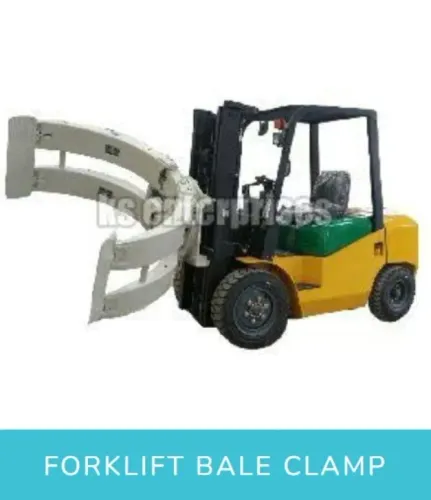
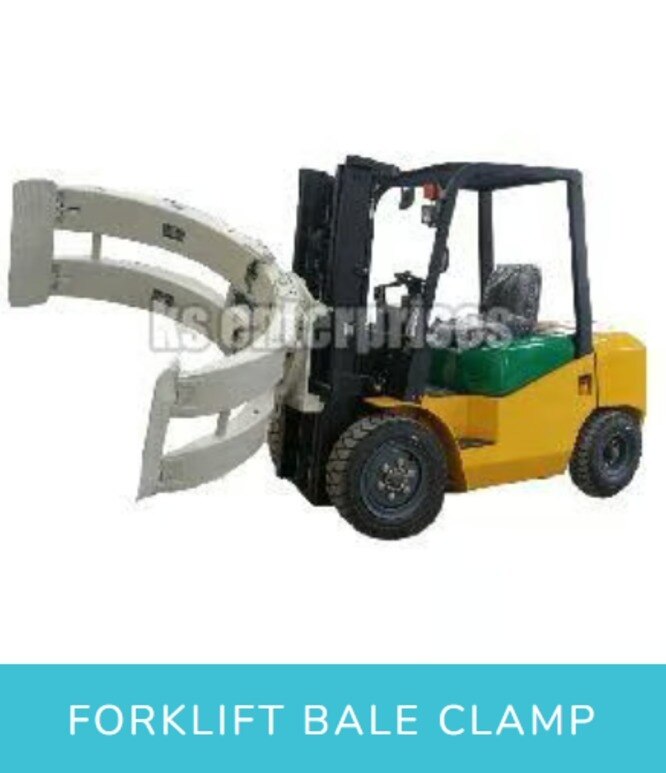
Confirm whether those figures use standard forks and carriage. A side-shifter, fork positioner, clamp or rotator adds weight and moves the load centre forward, so the reduced capacity must appear on the capacity plate and quotation.
Forks that are too short fail to support the pallet; excessively long forks push the load centre forward and increase collision risk. Specify pallet dimensions, entry direction, fork-section size, adjustment range and whether a second pair or special length is included.
Forklift tyres must match the floor and route, not just the purchase price.
| Tyre type | Advantage | Check before choosing |
|---|---|---|
| Pneumatic | Cushions rough yards | Air pressure, puncture exposure and ground clearance |
| Solid pneumatic | Resists punctures | Greater shock transmitted to the truck and load |
| Cushion or press-on | Suits smooth floors and tight turns | Broken surfaces and outdoor travel |
- Attachment weight and revised residual capacity
- Fork length, section and adjustment range
- Capacity at each required lift height
- Tyre type, size, load rating and approved operating surface
What equipment should be included in the quotation?
A quotation for a forklift truck in Delhi must show what arrives on the truck, what costs extra, and what the supplier will not provide. Do not accept “standard specification” without quantities, dimensions and part numbers.
| Item | Standard equipment | Optional or excluded unless stated |
|---|---|---|
| Forks and mast | Fork length, load backrest, overhead guard, mast stages and capacity plate | Side-shift, fork positioner, special forks and attachments |
| Controls and visibility | Seat restraint, steering, brakes, work lights and operator seat | Blue spot, warning beacon, reverse alarm, camera and telematics |
| Electric power | Battery chemistry, voltage, ampere-hours, mass, connector, charger output, charging time and warranty | Spare battery, battery-changing frame, second charger and charging-room installation |
| Engine power | Fuel type, tank or LPG mounting, emissions equipment, coolant and engine warranty | LPG cylinder, fuel, exhaust upgrade and engine-hour telematics |
| Handover items | Operator manual, parts book, warranty terms, tool kit and pre-delivery inspection report | Printed training material, translation and extended warranty |
| Site services | Delivery, assembly, commissioning, operating demonstration and operator training | Civil work, ramp repairs, electrical connection, recovery vehicle and ongoing maintenance |
The quotation should also state local technician coverage, response time, stocked wear parts, preventive-maintenance intervals, breakdown escalation and any loaner arrangement. Record the serial number, hour meter, battery condition, charger test, tyres, forks, chains, hoses, mast play, articulation play, brakes, alarms, lights and restraint at handover.
A battery substitution is not neutral: its mass can change stability and residual capacity.
How should you compare a named model and Delhi supplier before delivery?
Do not accept a truck because its model name says “2.5 tonne.” Check the residual capacity at your load centre and lifting height, then match the serial number on the truck, quotation and manufacturer’s specification sheet.
Record rated load, 500 or 600 mm load centre, maximum lift, collapsed mast height and residual capacity at your operating height.
| Check | Evidence before delivery | Hold acceptance if |
|---|---|---|
| Model identity | Manufacturer sheet, exact model, serial number and capacity plate agree | Any number differs or the plate is missing |
| Service support | Delhi response time, technician coverage, stocked wear parts, maintenance intervals and breakdown escalation in writing | Support depends on an unnamed third party |
| Truck condition | Signed pre-delivery inspection covering hour meter, battery and charger, tyres, forks, chains, hoses, mast, articulation, brakes, steering, alarms, lights and restraint | Defects, missing equipment or test results are undocumented |
| Operating fit | Demonstration with your pallet, rack aisle, load height, floor joints, ramp and outdoor route | The supplier demonstrates only an empty truck on a smooth floor |
Ask the articulated forklift supplier to demonstrate a full pick-and-place cycle at the heaviest load: approach, articulate, lift, reverse, turn and deposit. Measure clearance at rack ends and pedestrian crossings, and watch for mast sway, tyre scrub, steering play, brake delay and alarm faults.
For a forklift truck in Delhi that travels outside, obtain written limits for rainwater, dust, gradients, road joints, ground clearance and tyre use. K. S. Enterprises should provide these route-specific checks, not just a catalogue quotation, when comparing a model for your warehouse.
Related product
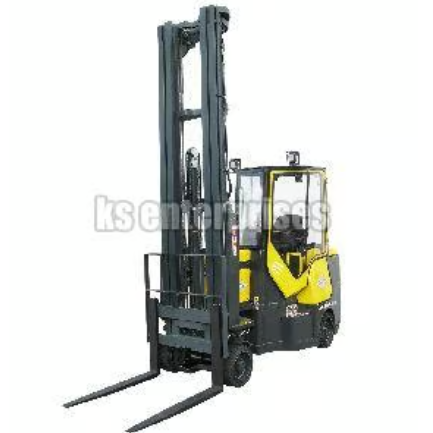 | Forklifts K. S. Enterprises is a trusted supplier of premium-quality Articulated Forklifts, offering advanced material handling solutions designed to improve... View product → |
Frequently asked questions
Which specifications define an articulated forklift truck?
Compare rated and residual capacity, lift height, load centre, overall width, turning radius, mast height, ground clearance, battery or fuel system, and travel speed. Residual capacity at your actual lift height matters more than the headline rating.
How do you calculate aisle width for an articulated forklift?
Measure the truck's published right-angle stacking aisle width, then add clearance for pallet variation, rack protection, floor unevenness and operator control. Check the result against your narrowest aisle, rack end and fire-exit approach.
How do load charts, forks, attachments and tyres change capacity?
Read the load chart for the exact mast, lift height and load centre. Side-shifters, clamps and other attachments add weight and move the load centre forward, reducing capacity. Fork length, tyre type and tyre condition also affect stability and clearance.
What equipment should be included in an articulated forklift quotation?
Request the truck, mast, fork dimensions, battery and charger or engine package, attachment, safety equipment, operator manual, load chart, commissioning, delivery, warranty, preventive maintenance scope and replacement-parts terms as separate line items.
How should you compare a model and Delhi supplier before delivery?
Compare written residual-capacity data, aisle trials, attachment compatibility, parts availability, technician response times, warranty exclusions, operator training and delivery inspection records. Ask the articulated forklift supplier to demonstrate the named configuration in your warehouse.