
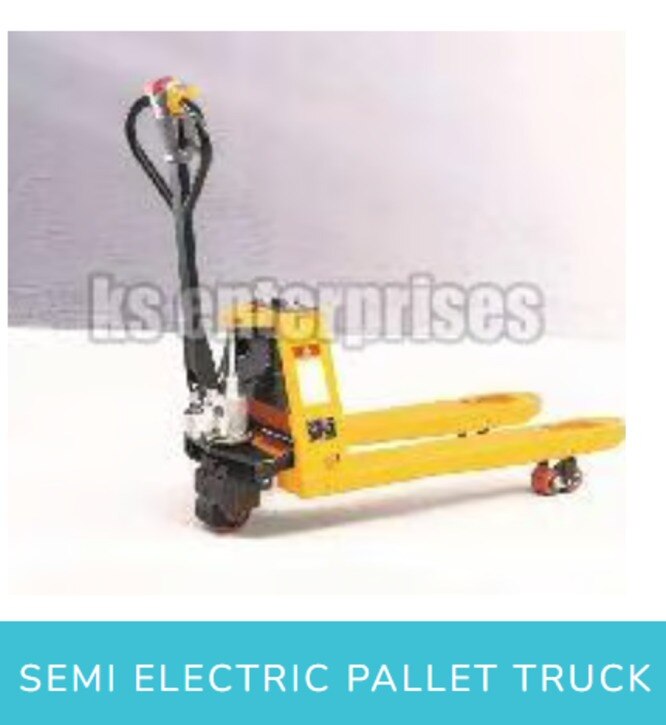
A powered pallet truck is useful when goods must move horizontally between docks, storage lanes, workstations and dispatch areas, but it is not a substitute for equipment designed to lift pallets into racks. By matching the truck to your load, route, battery system, floor plan and operating risks, you can choose equipment that works safely through the full shift rather than only during a showroom demonstration.
Key takeaways
- Match truck capacity and fork dimensions to your heaviest pallet.
- Measure aisle width, turning space and ramp gradients before choosing.
- Confirm battery capacity, charging time and service access before deployment.
- Test braking, steering, forks, controls and emergency stop with a load.
What does a powered pallet truck do across a warehouse workflow?
A powered pallet truck moves palletised goods horizontally through a warehouse, using an electric drive motor rather than manual pushing. It supports warehouse material handling equipment workflows where loads must travel repeatedly but do not need high-level storage.
At receiving, the operator removes pallets from the unloading area and carries them across the dock or floor to an inspection or staging zone. During put-away, the truck moves each pallet to its storage position at floor or low lift height.
It does not replace a stacker or forklift for racking pallets above the truck’s lift range.
For replenishment, the truck brings reserve pallets from bulk floor storage to pick faces. It then moves completed orders to staging, where loads are grouped by route or vehicle. At dispatch, it carries pallets to the dock and positions them for loading.
Check the actual route, including turns, dock transitions, ramps and pedestrian crossings, rather than judging performance on level showroom flooring.
| Equipment | How it operates | Best suited to |
|---|---|---|
| Hand pallet truck | Operator supplies all travel and lift effort | Occasional, short-distance moves |
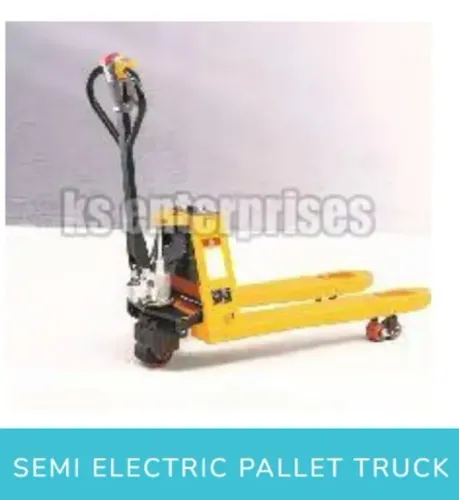
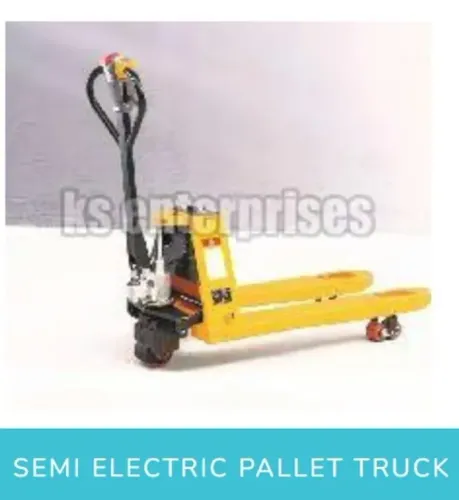
| Semi-electric pallet truck | Motor assists travel or lift, while the operator supplies the other function | Moderate movement with lower purchase or charging demands |
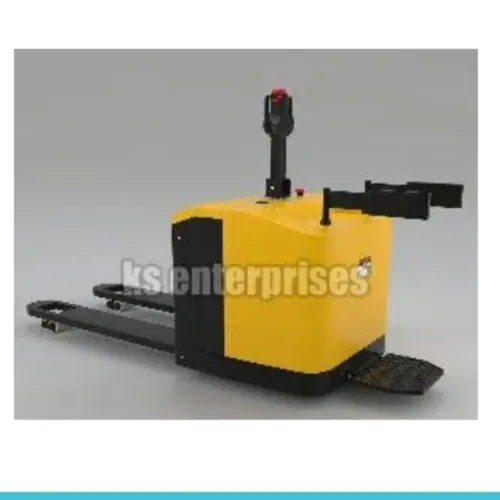
| Powered pallet truck | Battery-powered travel and hydraulic lift at low height; walk-behind or rider controls | Frequent horizontal moves across receiving, storage and dispatch |
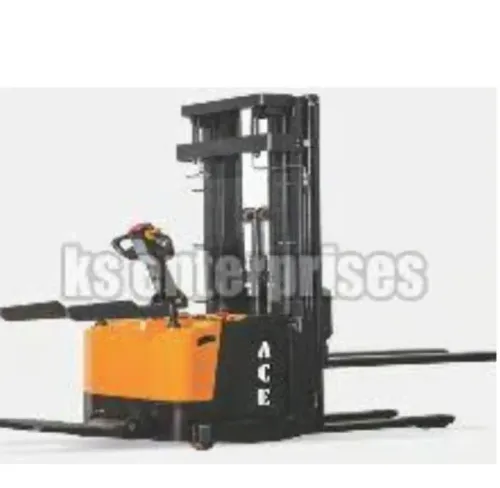
| Electric stacker | Powered travel with a mast that raises pallets vertically | Put-away into raised storage locations |
| Forklift | Seated or stand-on machine with mast, counterweight and higher lift capability | High stacking, heavier loads and varied attachments |
When is a powered pallet truck the right fit for a route and storage layout?
Choose a powered pallet truck for repeated horizontal moves of palletised loads within its rated capacity, across a sound floor and through aisles that provide its specified turning clearance. A walk-behind model suits short routes; a rider model earns its space when travel distances, traffic or daily throughput make walking the constraint.
| Option | Route and load conditions | Choose another option when |
|---|---|---|
| Hand pallet truck | Occasional, short moves on smooth, level floors; light-to-moderate loads | Repetition, distance, ramps or load weight make manual pumping and pulling tiring |
| Semi-electric pallet truck | Powered travel with limited manual handling; moderate routes and frequency | You need sustained throughput, rider travel or stronger ramp performance |
| Powered pallet truck | Frequent horizontal transport, including staging and dispatch; level or controlled-gradient routes with safe pedestrian separation | You need high vertical storage or the floor cannot support stable travel |
| Stacker | Pallet movement plus lifting to rack or mezzanine levels; narrow storage areas | The route is long and horizontal, or the load requires forklift-level reach |
| Forklift | Heavy loads, substantial lift height, uneven work areas or attachments | A compact pallet mover meets the job without combustion, counterweight or large turning space |
For ramps, keep the load uphill and follow the manufacturer’s travel direction and site risk assessment; never treat a dockboard as ordinary floor. Verify the board’s capacity includes the truck and load, secure it against slipping, and check the transition angle.
Cold rooms, wash-down areas and dusty floors require environmental protection, traction and battery provisions beyond a standard indoor truck.
Which specifications determine whether the truck will fit and control the load?
Choose by the tightest route and the heaviest, least-centred load—not the truck’s headline capacity. Rated capacity applies at a stated load centre and configuration; a long pallet, offset load, attachment or raised load can reduce usable capacity. Ask for the manufacturer’s capacity chart and match it to your warehouse material handling equipment conditions.
| Specification | Compare | Failure if mismatched |
|---|---|---|
| Capacity chart | Rated load at your maximum load centre, pallet height and attachment configuration | The truck becomes unstable or overloaded despite its advertised capacity |
| Fork dimensions | Fork length, width, thickness, adjustable spacing and pallet-entry openings | Forks miss the openings, damage pallets or leave the load unsupported |
| Turning space | Overall truck length, steering geometry and turning radius against the narrowest aisle and rack end | The truck clips racks, cannot align with a pallet or needs unsafe reversing |
| Clearance | Truck height, lowered forks, mast or guard height, doorways, lift cars, dockboards and floor transitions | The truck strikes a doorway or loses stability at a threshold |
| Speed and controls | Loaded and unloaded travel speeds, creep mode, braking, tiller layout, emergency stop and reverse protection | Excess speed causes load shift; poor controls delay stopping or trap an operator |
Measure the narrowest turn with a loaded pallet, not an empty truck. Check floor flatness, maximum gradient, dockboard rating and transition angle; a compact truck still needs secure crossing equipment and adequate clearance. Select speed and controls for pedestrian traffic, sightlines and operator reach, then confirm the actual route during acceptance testing.
How do the battery and maintenance plan affect daily availability?
Match the forklift battery and charger to the truck’s actual shift profile, not ampere-hours alone. Count travel intensity, lift frequency, ambient temperature, battery age, charging opportunities and voltage compatibility. A mismatched system causes low-voltage cut-outs during peak work and shortens battery life.
| Battery system | Best fit | Availability requirement |
|---|---|---|
| Lead-acid | Fixed shifts with scheduled charging | Designated charging space, ventilation, watering or electrolyte procedures, battery-changing equipment and acid controls |
| Lithium-ion | Multiple shifts or frequent opportunity charging | Compatible charger, battery-management system and manufacturer-approved charging practice |
Charging is a material-handling process, not a spare corner of the warehouse. Keep smoking and ignition sources away, protect chargers from impact, provide ventilation, and stock controls for electrolyte exposure and spills. Without a designated charging or battery-change area, the fleet is not operationally ready.
Before each shift, inspect the powered pallet truck for:
- Tiller movement and return, travel controls, emergency reverse button and emergency disconnect
- Brake operation, horn, warning devices and visible alarms
- Forks, welds, wheels, fasteners and signs of damage
- Lift and lowering controls, hydraulic leaks and unusual drive-unit noise
- Battery connector condition and charger compatibility
Remove a truck with a safety-critical defect from service until repaired, and record the truck identity and specific defect rather than writing “OK.”
Schedule forklift service and repair by operating hours, duty severity and calendar time. Include brake performance, steering, drive noise, forks, welds, hydraulics, lift chains where fitted, connectors and fasteners; correcting small faults early prevents a breakdown during dispatch.
How should you test a powered pallet truck before putting it into service?
Do not accept a showroom demonstration as proof of readiness. The truck must complete the route, load and working conditions it will face inside your Gurugram warehouse.
1. Write the site specification before requesting final confirmation. State floor condition and maximum gradient, narrowest aisle, door and lift dimensions, pallet size, maximum load centre, load weight, operating hours, ambient temperature, dust, humidity, wash-down exposure and pedestrian traffic. Include the charging or battery-change location.
2. Run a documented acceptance test on the actual route. Check loaded travel, braking, turning at the narrowest point, ramp and dock transitions, fork entry, emergency-stop operation and reverse protection. Confirm pedestrian segregation, charger access, impact protection and a recovery or towing method if the truck fails in an aisle or on a ramp.
3. Make the training plan equipment- and workplace-specific. Operators need supervised practice, a practical performance evaluation and instruction on charging, daily checks, load limits, pedestrian rules and emergency actions.
Repeat familiarisation when controls, attachments, truck type or warehouse layout changes; where OSHA’s rule applies, evaluate operators at least every three years and after defined unsafe events.
4. Ask the supplier for the manufacturer’s capacity chart, not only the headline rating. Check reduced capacity for long or offset loads, attachments and elevated loads, plus cold-store battery provisions, sealed electrical components, traction wheels and suitable lubricants.
K. S. Enterprises can help compare these details across warehouse material handling equipment, including a powered pallet truck for warehouse material handling equipment in Gurugram.
Related product
 | Pallet Trucks K. S. Enterprises is a trusted supplier of high-performance Powered Pallet Trucks, delivering efficient and reliable material handling solutions for... View product → |
Frequently asked questions
What does a powered pallet truck do in a warehouse?
It moves palletised goods horizontally between receiving, storage, picking, staging and dispatch areas without manual pushing.
When is a powered pallet truck the right fit?
Choose one for repeated horizontal transport on defined routes when loads do not require high-level storage.
Which specifications determine whether it will fit and control the load?
Check rated capacity, load centre, fork length and width, minimum turning radius, overall width, lift height, travel speed and braking system.
How do the battery and maintenance plan affect availability?
Compare battery voltage, amp-hour capacity, charging time, duty cycle and charging facilities, then schedule inspections and forklift service and repair.
How should you test a powered pallet truck before service?
Test unloaded and loaded travel, steering, braking, horn, emergency stop, fork movement, controls, battery condition and operation in the intended aisles.