
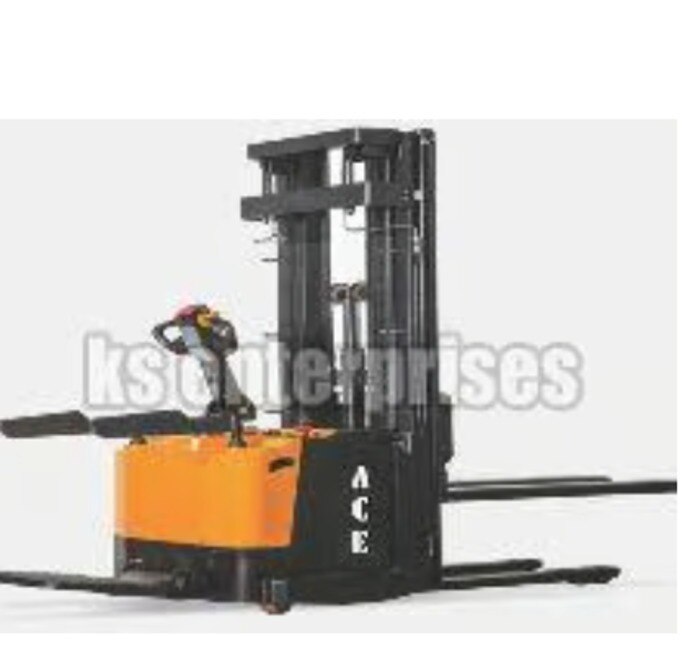
An electric stacker normally uses a traction battery built for industrial equipment, not a conventional car battery and not automatically the same pack fitted to a counterbalance forklift. By checking the truck’s data plate, battery label, dimensions, weight and charger details, you can identify a safe replacement and avoid a battery that fits physically but fails electrically or affects stability.
Key takeaways
- Buy a rechargeable traction battery, never an automotive starting battery.
- Match voltage, amp-hour capacity, dimensions, connector and battery weight.
- Confirm the charger supports the battery’s chemistry and charging voltage.
- Provide ventilation, spill control and a protected charging area at work.
What battery does an electric stacker use?
An electric stacker uses a rechargeable traction battery, not an automotive starting battery. Pedestrian walkie stackers commonly use 24-volt systems; rider stackers can require higher voltages. Confirm the make, model, configuration and data plate before ordering.
Do not choose an industrial stacker battery merely because it is labelled “forklift battery.” A counterbalance-forklift battery may be too large, heavy, light or incompatible with the connector, polarity, retention system or charger. A starting battery supplies short bursts; a stacker needs sustained deep-cycle energy for travel and lifting.
| Battery option | Operating difference |
|---|---|
| Flooded lead-acid | Lower initial cost; requires ventilation, cleaning, water-level checks and specified equalisation |
| Maintenance-free lead-acid | Less routine topping-up; still needs its approved charging profile |
| AGM or gel | Sealed construction; no routine watering; charger settings remain critical |
| Lithium-ion | Supports opportunity charging and reduces watering work; requires a compatible battery-management system, charger and truck |
The battery also acts as counterweight. An unapproved lighter pack can change stability, braking, load-centre performance and rated lifting capacity.
Before buying, check the stacker nameplate on the chassis, mast or control area and the battery label on the case or pack. Record:
- Model code, voltage and ampere-hour rating
- Case length, width, height and delivered weight
- Terminal layout, polarity, connector, cable exit and retention method
These electric stacker battery requirements determine compatibility; a battery that fits the tray can still be unsafe.
Which specifications must match before you order?
Before ordering, give the supplier the stacker make, model and serial number, not just the phrase “forklift battery”. The electric stacker battery requirements also include nominal voltage, Ah rating, case length, width and height, delivered weight, terminal layout, polarity, connector type, cable exit, retention method and battery-tray clearance.
Find the stacker nameplate on the chassis, mast or operator-control area. Find the battery label fixed to the case or pack, then record the model code, voltage and Ah exactly as printed. Photograph the terminal arrangement and connector. Measure the tray with the battery removed only under an approved safe procedure.
| Choice | What to check | What goes wrong |
|---|---|---|
| Oversized battery | Dimensions, weight, charger output and tray clearance | It may not fit, may overload retention hardware, require a different charger and increase cost |
| Undersized battery | Rated capacity, delivered weight and duty-cycle runtime | Low-voltage cut-outs and shortened service life can follow |
| Correctly matched battery | OEM data, physical fit, weight and charger compatibility | The stacker receives usable capacity without compromising its rating |
Battery weight is part of the counterbalance system. A pack that fits but is materially lighter can alter stability, braking and load-centre performance, invalidating the rated capacity.
Select capacity from travel distance, load weight, lift height, operating hours, temperature, allowable voltage sag and charging opportunities. Ramps, uneven floors and long routes matter in electric stacker warehouse use; ask for runtime at your actual discharge rate and temperature, not from the printed Ah figure alone.
How do battery chemistry and charger compatibility change the choice?
Chemistry changes both how an industrial stacker battery behaves during a shift and how you must recharge it. Flooded lead-acid has lower initial cost and established service support, but charging controls, cleaning, water-level checks and equalization are part of ownership when the battery maker specifies them.
| Chemistry | Operating implications | Charging implications |
|---|---|---|
| Flooded lead-acid | Proven, serviceable and lower-cost; requires watering and cleaning | Use the specified profile, ventilation and equalization cycle |
| Maintenance-free lead-acid | Reduces routine topping-up; still needs correct handling | Match the charger profile and follow the maker’s ventilation instructions |
| AGM | Sealed design reduces routine watering; incorrect charging still damages it | Use its specified voltage, current and charging curve |
| Gel | No routine topping-up; sensitive to an unsuitable charging algorithm | Use the charger setting approved for gel batteries |
| Lithium-ion | Reduces watering work and supports opportunity charging | Battery, battery-management system, charger and truck must communicate and work together |
Read the charger nameplate before connecting anything. Check its output voltage, charging current, connector, battery-chemistry setting and charging curve.
Never connect lithium-ion to an ordinary lead-acid charger because the nominal voltage looks similar. The reverse mistake can overcharge or undercharge, cause electrolyte loss, create thermal risk or promote lead-acid sulfation. Treat the charger as part of the battery system, not a universal accessory.
What charging setup does an electric stacker need at work?
An electric stacker needs a charging setup matched to its battery design and warehouse conditions. A removable industrial battery lets you exchange packs or charge one away from the truck, but the site must safely move its weight.
- Provide approved rollers, a battery-changing table, lifting equipment or side-extraction hardware; never drag a heavy pack from its compartment.
- Plan downtime when the battery is integrated into the stacker, because the truck remains tied to the charger during charging.
- For lead-acid batteries, use a designated area with adequate ventilation. Prohibit smoking and open flames, control sparks, provide eye and hand protection, and keep electrolyte neutralising material and flushing facilities available.
- Check distilled-water levels only when the battery design requires topping up. Do not water sealed, AGM, gel or lithium packs.
- Match the battery to actual electric stacker warehouse use. Ramps, dock plates, uneven floors and long travel routes increase energy demand; cold storage and high heat reduce available capacity.
- Ask for expected runtime at the stated discharge rate, temperature and duty cycle. A printed Ah figure is not a guaranteed shift length.
A removable battery reduces charging downtime only if the exchange process is safe and practical. An integrated pack reduces handling but makes charging opportunities and shift planning more important.
A battery that finishes its shift on smooth indoor floors can fall short when the same stacker travels farther, climbs ramps or works in an unconditioned warehouse.
What should you ask a Gurugram battery supplier before buying?
A supplier quote should match the replacement to the stacker’s OEM specification, not merely the search phrase “electric stacker for forklift battery in Gurugram.” Send the make, model, serial number, battery data plate, charger model, tray measurements and photographs of the connector and terminals.
- Request the quoted voltage, Ah rating, chemistry, case length, width, height and delivered weight.
- Confirm polarity, terminal layout, connector type, cable exit and retention hardware in writing.
- Ask for charger compatibility, charging instructions and electrolyte or spill provisions where relevant.
- Request cell or pack warranty terms, a test certificate, local installation support and old-battery take-back.
- Ask how the supplier will check the truck’s rated capacity after a chemistry or weight change.
- Confirm that your site has suitable equipment to exchange the battery safely, including rollers, lifting equipment or a battery-changing table.
K. S. Enterprises can help a Gurugram buyer when the requirement involves matching an electric stacker, battery and support service rather than buying a generic pack. A supplier describing itself as a “forklift battery supplier in Gurugram” has not proved compatibility; the documented specification and after-sales process do.
Related products
 | Industrial Stackers K. S. Enterprises is a trusted supplier of high-quality Electric Stackers, offering efficient and reliable material handling solutions for... View product → |
 | Industrial Stackers K. S. Enterprises is a trusted supplier of premium-quality Semi Electric Stackers, offering efficient and economical material handling solutions for... View product → |
Frequently asked questions
What battery does an electric stacker use?
An electric stacker uses a rechargeable traction battery. Pedestrian walkie stackers commonly use 24-volt batteries, while rider stackers can require higher voltages. Check the data plate and manufacturer documentation before ordering.
Which specifications must match before ordering an electric stacker battery?
Match the battery voltage, amp-hour capacity, physical dimensions, connector, terminal arrangement, lifting points and permitted battery weight. Confirm the battery fits the compartment and does not exceed the stacker’s rated weight range.
How do battery chemistry and charger compatibility affect the choice?
Lead-acid and lithium-ion batteries require different charging profiles, connectors and maintenance routines. Use a charger rated for the exact chemistry, voltage and capacity; never charge a lithium-ion battery with an unapproved lead-acid charger.
What charging setup does an electric stacker need at work?
Provide a designated charging area with the correct charger, electrical protection, cable clearance and ventilation. Lead-acid charging also requires procedures for electrolyte exposure, spill response and keeping ignition sources away.
What should you ask a Gurugram battery supplier before buying?
Give the supplier the stacker make, model, serial number, battery data-plate details and charger model. Ask for confirmation of voltage, capacity, dimensions, connector, chemistry, warranty, installation method and local service support.