
A semi-electric pallet truck can lose travel, lifting ability, braking control or battery runtime for reasons ranging from a released interlock to a failing hydraulic seal. By separating powered travel from manual or assisted lifting and following a safe diagnostic order, you can identify simple operating faults, recognise unsafe conditions and give a technician useful repair information.
Key takeaways
- Test the tiller dead-man switch before investigating the drive motor.
- Check battery voltage, charger output and connector condition after a travel failure.
- Stop using the truck if forks drift down or the brake fails.
- Match repair support to your warehouse truck’s model and operating load.
How a Semi-Electric Pallet Truck Works—and Where Problems Begin
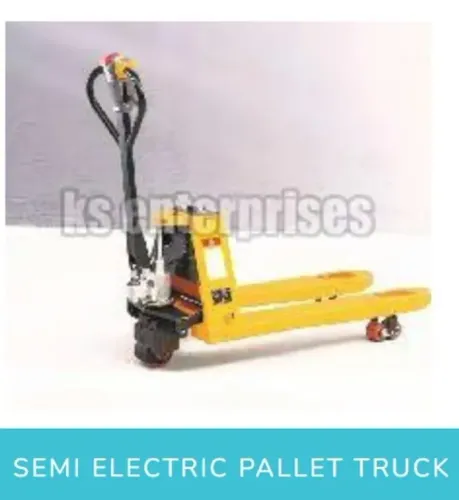
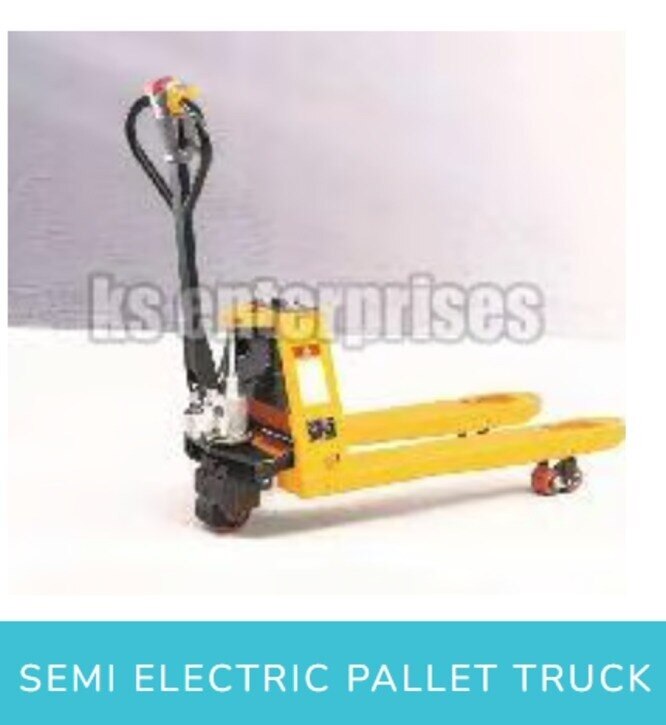
A semi-electric pallet truck uses battery power for travel, while fork lifting remains manual or uses a separate powered assist, depending on the model. It is not a full-electric pallet truck. The tiller steers the truck and carries controls for forward, reverse, speed and braking; its dead-man switch also enables movement.
| Function | What operates it | Where trouble begins |
|---|---|---|
| Travel | Battery and drive motor turn the drive wheel | Low battery, loose connector, fuse, controller or motor fault |
| Steering | Operator moves the tiller mechanically | Bent tiller, damaged linkage or restricted wheel |
| Fork lifting | Hand pump handle or lift motor drives the hydraulic unit | Low oil, air, overload, valve or cylinder-seal fault |
| Lowering | Release lever opens the hydraulic valve | Sticking valve or damaged linkage |
| Safety stop | Emergency-stop, key, dead-man and brake circuits interrupt travel | Open interlock prevents movement |
The battery feeds the controller, which sends current to the drive motor after the key, emergency-stop, tiller and brake circuits allow travel. The motor turns the drive wheel and pulls the chassis, while the forks carry the load through the load wheels.
If the battery is discharged, the truck might still be pushable, but pushing does not restore powered travel or safe ramp performance.
Searching for a semi electric pallet truck for material handling equipment in gurugram is incomplete without specifying floor, ramp, hours, capacity and lift method. Problems often begin when operators treat a no-travel condition as a failed motor instead of checking the fault display and interlock sequence.
No Travel, Erratic Movement or Sudden Shutdown: Electrical Faults to Check
If the forks lift but the truck will not travel, do not replace the drive motor first. An open travel interlock, weak battery, disconnected plug, blown fuse or failed key switch can stop propulsion while leaving lifting available.
Begin pallet truck troubleshooting with the truck safely isolated, then record the battery type, fault code and exact symptom. Never bypass an emergency-stop, tiller dead-man or brake interlock to make the truck move.
- Release the emergency stop, turn the key on and hold the tiller in its travel zone. Check that the brake releases and the display clears its fault code.
- Inspect the battery plug, terminals, fuse, controller connector and low-mounted wiring for looseness, oxidation, crushed insulation, dust or monsoon moisture.
- Check battery voltage at rest, then at the controller input while commanding travel. A sharp voltage drop points to a weak cell, poor terminal, high-resistance plug or undersized cable; normal no-load voltage proves little.
- Test lift and travel separately. If both functions lose power, suspect the battery, main fuse, key circuit or controller supply. If lift works and the controller receives stable voltage, examine the travel circuit.
- Listen and observe: a click without wheel movement suggests brake release, controller output or motor-circuit trouble; jerking, cut-outs or heat under load points to resistance, controller protection or motor faults.
A motor winding, Hall sensor, controller or wiring failure becomes more credible after interlocks pass, voltage remains stable under load and connectors test sound. Stop testing if wiring heats, insulation is damaged or the truck shuts down repeatedly.
No Lift, Slow Lift or Forks That Drift Down
A truck that will not lift, lifts slowly, or lets its forks sink has a hydraulic or mechanical fault, not a traction fault. Check the hydraulic-oil level and condition: low or contaminated oil, a blocked suction strainer, or air in the circuit restricts flow and can make lifting weak or uneven.
Follow the manufacturer’s bleeding procedure for trapped air.
Match the symptom before replacing parts:
- No lift at all: check for low oil, air, a failed pump, or a lowering valve stuck open. Remove the load before testing.
- Lift fails only under load: verify the rated capacity and load centre. An overload exposes a weak pump, an incorrectly set relief valve, or internal hydraulic bypass.
- Forks drift down with the control released: suspect a leaking cylinder seal or a lowering valve that does not close. A misadjusted lift-control linkage can hold the valve partly open.
- Forks sit at different heights: inspect for bent forks, damaged rollers, twisted linkage, or cylinder-side mechanical damage. Do not straighten a bent fork with heat.
Among semi electric pallet truck problems, a truck that raises unloaded but slows under its rated load needs a pressure and leak test. Continued use can damage the pump, cylinder or frame; isolate it and record the load, oil condition and exact drift rate for the repair technician.
Battery, Charger, Brake and Wheel Problems That Reduce Reliability
A discharged battery is not the only cause of lost travel. Inspect the battery case for swelling, cracks, leakage, heat damage and loose or corroded terminals. Check the connector for water entry, dust and burned contacts. For lead-acid batteries, check electrolyte level only as the manufacturer specifies; never open a sealed battery.
Match the charger to the battery chemistry and voltage. A green lamp does not prove a full charge if the charger plug, fuse or connector is damaged. Record the charger’s indicator pattern and measure battery voltage under load with trained service support.
Before returning the truck to work, use this pallet truck troubleshooting checklist:
- Read the fault display and record the battery type, voltage and code.
- Release the emergency stop, check the key switch and confirm the tiller dead-man switch changes state.
- Inspect fuses, battery plugs, low-mounted wiring and brake-switch connectors for looseness, corrosion or heat marks.
- Confirm that the charger starts, completes its cycle and does not trip or overheat.
- Test lifting and travel separately; never bypass a brake or dead-man interlock.
- Remove the truck from service for weak braking, failure to stop, travel with the tiller upright, steering that binds, a cracked or bent fork, flat-spotted or damaged wheels, seized bearings, grinding or clicking noise, burning smell, or a warning alarm that remains active.
A brake that will not release can stop travel; a brake that will not hold can cause uncontrolled movement. Isolate the truck until a technician checks the mechanical brake, microswitch adjustment and electromagnetic release.
A Safe Repair Decision for Gurugram Warehouse Operations
Stop troubleshooting and isolate the truck when it loses braking, moves without tiller control, shows burnt wiring, leaks hydraulic oil, overheats, or repeats a fault after the interlocks and power supply test correctly. Do not bypass the emergency stop, brake switch or tiller dead-man control.
Escalate to semi electric pallet truck repair before replacing a drive motor or controller.
Give the repair provider a usable fault record:
- Exact symptom: no travel, intermittent drive, no lift, slow lift or fork drift
- Battery chemistry, voltage, age and charge reading under load
- Fault code, warning-light pattern and charger model
- Fork length, width, rated capacity and load centre
- Wheel material, floor condition, ramp percentage and load weight
- Daily operating hours, shifts and distance travelled
- Recent water entry, monsoon exposure, dust buildup, impact or wiring work
- Photos of connectors, fuses, tyres, forks and any fluid leak
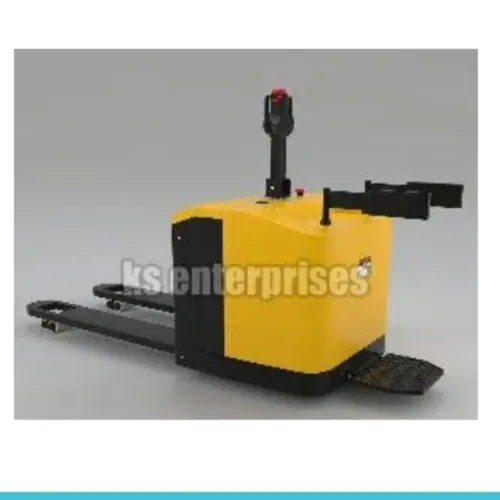
A semi-electric truck is the wrong fit when operators repeatedly move heavy pallets over long distances, climb ramps, cross uneven yard surfaces or load at high volume. Its powered travel still has lower sustained productivity and gradient capability than a full-electric truck, while manual lifting or battery dependence can slow the operation.
For warehouse material handling equipment in Gurugram, K. S. Enterprises can help compare a semi-electric, full-electric or hand truck against these duty details rather than the search phrase alone.
Related product
 | Pallet Trucks K. S. Enterprises is a trusted supplier of premium-quality Semi Electric Pallet Trucks, offering reliable, efficient, and cost-effective material... View product → |
Frequently asked questions
How does a semi-electric pallet truck differ from a full-electric model?
A semi-electric pallet truck uses battery power for travel, while lifting remains manual or uses a separate powered assist. A full-electric model powers both travel and lifting.
What should you check when a semi-electric pallet truck will not move?
Inspect the battery charge, battery connector, emergency stop, tiller dead-man switch, travel controls, wiring and drive-wheel area. Do not bypass a safety switch.
Why do pallet truck forks fail to lift or drift down?
Check the hydraulic oil level, lift control, pump operation and visible leaks. Forks that drift down under load require the truck to be removed from service until repaired.
When should you stop using a semi-electric pallet truck?
Stop immediately for brake failure, uncontrolled movement, damaged wiring, exposed battery terminals, hydraulic leaks or forks that lower without control.