
Choosing a clamp for masonry is not a simple matter of matching a product name to a forklift tonne rating. You need to compare the load, clamp geometry, hydraulics, residual capacity, tyres and site conditions so the attachment grips securely without crushing or dropping the product.
Key takeaways
- Match clamp pads and engagement length to the masonry load.
- Check attachment weight, load centre and residual forklift capacity.
- Use independent arm control for loose, uneven or fragile blocks.
- Request dimensions, pressure range, capacity and compatibility in writing.
Which masonry loads can a brick block clamp handle?
A brick block clamp handles non-palletized masonry between opposing hydraulic arms or pads. Suitable loads include individual bricks, strapped brick packs, concrete blocks, pavers, AAC blocks and other masonry units. Choose a compact, banded-bundle clamp for uniform packs; loose or uneven blocks need independently adjustable arms, longer engagement and pads shaped to hold irregular surfaces.
Fixed arms suit repeatable load sizes, while independently adjustable arms accommodate different widths. Side-shift improves placement accuracy. A 360-degree rotator turns the load, but adds weight, height and cost while reducing residual forklift capacity.
| Option | Handling method | Suitable use |
|---|---|---|
| Standard forks | Support a pallet from below | Palletized masonry; they do not secure a loose pack |
| Fork positioner | Changes fork spacing without clamping | Different pallet widths, not loose blocks |
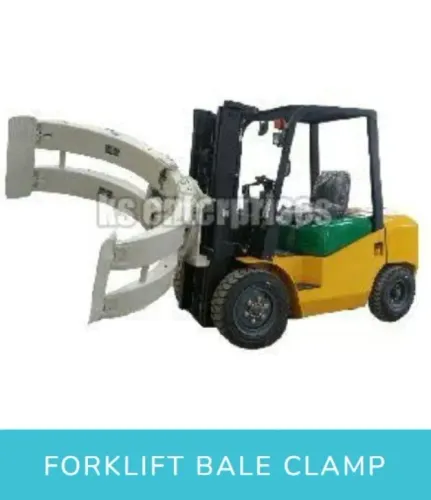
| Bale clamp | Uses shaped, padded arms | Bales and materials with different compression characteristics |
| Rotator | Turns an attached load | Reorientation; not primarily load security |
| Brick block clamp | Grips between opposing pads | Non-palletized masonry units and strapped packs |
Operate the attachment in this order:
- Position the pads around the load and engage enough height and depth to stop upper courses tipping or shedding.
- Close the arms with controlled pressure, then lift slightly to confirm stability.
- Travel with the load centred and kept low.
- Lower the load fully before releasing pressure and opening the arms.
A clamp that grips only a narrow top section can let lower units slide or upper courses fall, even when the forklift attachments have adequate rated capacity.
Which clamp dimensions and pressure controls should you specify?
A brick block clamp should be sized around the actual load unit, not the product label. Give the supplier:
- Maximum and minimum bundle width, height, length and weight; centre of gravity; banding or packaging method; and surface condition.
- Whether each load is dry, wet, loose or uneven.
The working opening range matters more than nominal capacity alone. The opening must accept the widest pack, while arm length and pad height must overlap enough of the load to stop sliding, rotation or upper-course shedding.
| Pad option | Advantage | Risk or use condition |
|---|---|---|
| Rubber-faced, softer pads | Protect finished pavers and reduce marking | Wear faster and lose grip when contaminated |
| Harder, profiled faces | Tolerate abrasive yards and repeated contact | Increase edge-damage risk |
| Replaceable pad faces | Restore grip without replacing the full arm | Preferable for high-cycle operations |
Specify pad shape, face material and replacement availability. Ask for clamp pressure from the attachment manufacturer and a controlled test load, not a universal pressure rule. The quotation must state the pressure-control or relief arrangement, approved pressure range and test method.
Too little pressure lets the load move; too much crushes brick edges, marks surfaces or damages hollow blocks.
Add side-shift only when placement accuracy justifies its extra weight and complexity.
How do you confirm the clamp fits the forklift and preserves capacity?
A clamp fits safely only when its mounting interface, hydraulics and residual capacity match the exact forklift, not merely a 2-tonne or 3-tonne badge.
1. Give the material handling equipment supplier the forklift make and model, mast type, carriage class, carriage opening, mounting dimensions, rated capacity, rated load centre and tyre configuration. Confirm the available auxiliary hydraulic functions, oil-flow and pressure limits, hose routing and quick-coupler details.
2. Measure the carriage interface on site and confirm the class and mounting dimensions against the attachment drawing. Do not infer compatibility from the truck’s tonne rating; a mismatched hook, bar or opening can prevent secure engagement.
3. Obtain the manufacturer’s residual-capacity figure for that truck, mast, tyre setup, clamp weight and required load centre. The clamp removes payload through its own weight, then moves the load centre forward. A rotator, side-shift carriage, long arms or heavy pads increase the reduction.
4. Match hydraulic requirements to the auxiliary circuit. Inadequate flow makes the arms slow; excessive pressure can damage cylinders, seals and hoses. Cycle the mast and attachment fully to confirm hoses have clearance and cannot pinch or abrade against the carriage, mast or ground.
5. Require a revised capacity plate or written capacity information after fitting the forklift attachment. In the United States, OSHA requires the forklift manufacturer’s prior written approval for this modification. Do not lift until that information states the permitted load and load centre.
The truck’s residual capacity—not the clamp’s nominal rating—controls the safe lift. Ask for the calculation in writing.
How should you handle fragile or unstable masonry with the clamp?
Reject the load, repack it, or change the handling method if strapping is loose or missing, the pack is damaged, surfaces are wet, edges are broken, or weight is unevenly distributed. Never lift by bands alone.
Keep the centre of gravity between the pads, engage enough of the pack to prevent rotation, and do not grip only a narrow top section.
- Set the clamp pressure using the attachment manual and a controlled test load. Do not copy a pressure setting from another clamp or masonry product.
- Lift the test load a short distance and check for slipping, crushed edges, pad marks and shifting.
- Travel a short, controlled route, then stop and recheck the pack before routine work.
- Set lifting height, travel speed and ground limits from the forklift and attachment manuals and the site risk assessment. Verify those limits on the actual route.
- Confirm clear visibility, separate pedestrians, and assess ramps, potholes and overhead obstructions before operating.
Use the mast tilt specified in both manuals; excessive tilt can move the load outside the pads. Include forklift tyres in the clamp decision: pneumatic tyres cushion rough ground and provide traction but invite punctures, while solid or resilient tyres resist punctures but transmit more shock and can behave differently on wet or uneven surfaces.
Inspect pads, cylinders, hoses, couplers, carriage locks and tyres before each shift.
What should a supplier include in a brick block clamp quotation?
A usable quotation describes the truck, load and test—not just a clamp model and tonne rating. Give a material handling equipment supplier measured load dimensions, bundle weights, photographs of the carriage and hydraulic couplers, and details of the yard surface, ramps, potholes and travel route.
That evidence turns “brick block clamp for material handling equipment supplier” into a site-specific buying brief.
Ask for a written specification that names:
- Compatible forklift make and model, mast type, carriage class, mounting dimensions, attachment weight and visibility impact.
- Working opening range, arm length, pad height, pad material, replaceable-pad availability, and fixed or independently adjustable arms.
- Rated capacity at stated load centres, pressure and flow requirements, auxiliary hydraulic connections, hose routing, and any pressure-relief setting.
- Side-shift or 360-degree rotation options, with the added weight and capacity effect stated rather than hidden in the attachment price.
- Inspection schedule, lubrication points, operating instructions and maintenance requirements.
Require the supplier to calculate residual capacity for your exact mast, tyres, attachment, load weight and load centre. Request manufacturer approval, revised capacity information or a new capacity plate, and updated operating instructions where the attachment changes the truck.
K. S. Enterprises, a Gurugram-based material handling equipment supplier, should receive this evidence before preparing a site-specific quotation. Insist on a controlled commissioning test using your actual brick, block, paver or AAC load, with the approved pressure setting and travel route recorded.
The result should be a clamp matched to the forklift and load, not to the truck’s badge.
Related product
 | Forklift Attachments K. S. Enterprises is a trusted supplier of high-quality Brick Block Clamps, offering advanced material handling solutions for the construction,... View product → |
Frequently asked questions
Which masonry loads can a brick block clamp handle?
A brick block clamp can handle individual bricks, strapped brick packs, concrete blocks, pavers, AAC blocks and other masonry units when the clamp is sized for their dimensions, weight and surface condition.
Which clamp dimensions and pressure controls should you specify?
Specify minimum and maximum opening, pad height and width, engagement depth, attachment weight, rated capacity and hydraulic pressure control. Uniform packs suit compact banded-bundle clamps; uneven loads need independently adjustable arms and shaped pads.
How do you confirm the clamp fits the forklift and preserves capacity?
Give the supplier the forklift make and model, rated capacity, load centre, fork carriage class, hydraulic flow and pressure. Confirm the attachment weight and revised capacity from the forklift data plate or manufacturer calculation.
How should you handle fragile or unstable masonry with the clamp?
Use broad, high-friction pads, controlled hydraulic pressure and enough engagement depth. Centre the load, keep it low while travelling, inspect for cracks or loose units and stop if the pack shifts.
What should a supplier include in a brick block clamp quotation?
Request the clamp model, opening range, pad dimensions, rated capacity, attachment weight, pressure and flow requirements, carriage compatibility, warranty, delivery scope and installation or commissioning charges.