
A fork rotator is useful when a forklift must turn, invert or precisely orient a retained load, but the attachment also changes the truck’s capacity, clearance and hydraulic requirements. You will be able to match the rotation angle, load-retention method, forklift and site conditions before approving a purchase or installation.
Key takeaways
- Use 180-degree rotators for defined tipping; choose 360-degree models for repeated inversion.
- Recalculate capacity using attachment weight and the new combined load centre.
- Confirm aisle width, ceiling clearance, floor condition and load stability before selection.
- Record rotator capacity, hydraulic requirements, inspection results and operator instructions before commissioning.
What a Fork Rotator Does and Which Industrial Jobs Justify It
A fork rotator turns the forks and their load around a horizontal axis, allowing the operator to tip, invert or orient the load without transferring it to another machine. A 180-degree model suits a defined tipping action; a 360-degree model suits repeated inversion or precise orientation at different angles.
Fork rotator applications are justified when rotation removes a manual handling step or a second transfer. Common production tasks include:
- Emptying bins, totes and hoppers into a machine, skip or receiving container.
- Turning moulds, fixtures, foundry boxes and process containers for access, cleaning or discharge.
- Repositioning palletised loads when the receiving process requires a different face or orientation.
- Inverting scrap, castings or rejected parts into a sorting or recovery container.
| Option | Motion | Best-fit industrial job |
|---|---|---|
| 180-degree rotator | Turns the load through a fixed half-turn | Controlled tipping, emptying a bin, or reversing a pallet once |
| 360-degree rotator | Provides continuous rotation through repeated turns | Repeated inversion, process alignment, or precise orientation at several angles |
The attachment name does not prove suitability. For industrial material handling equipment, match the rotator to the load’s mass, centre of gravity, dimensions, fork-pocket arrangement and required angle.
Forks must enter far enough and support the load evenly; a bare rotator cannot safely retain loose goods, drums, reels or top-heavy containers without a cage, clamp or purpose-built cradle.
How to Run a Rotation Cycle Without Losing Load Control
A safe cycle begins with the container, not the attachment. In fork rotator applications, confirm that the bin, tote, hopper, pallet or cradle is designed for the intended angle and has no cracks, loose panels or projecting parts.
1. Inspect the load and its cradle. Confirm the mass, centre of gravity and retention points before approaching.
2. Enter both forks fully into the pockets. Keep the forks equally positioned and support the load close to its intended centre of gravity.
3. Secure the load before lifting. Engage the cradle, locking bar, clamp or other retaining device; do not rely on fork friction when rotation can shift the centre of gravity.
4. Lift only enough to clear the floor and nearby obstacles. A high load increases the consequences of a spill and reduces stability.
5. Stop in a cleared exclusion zone. Keep people, racks, columns, vehicles and overhead obstructions outside the full rotation envelope, then rotate at controlled speed.
6. Return the load to its stable receiving position before placing it. Lower it onto the floor, pallet or support without pushing or dragging the container.
7. Return the forks to the travel position and lower them before travelling. Check that the load is stable and the rotation mechanism is locked or parked.
Loose goods, drums, reels, bales and unstable or top-heavy containers need a clamp, bale clamp, drum handler, tipping attachment, cage, purpose-built cradle or dedicated process machine. A bare fork rotator does not retain every load safely. Include these checks when evaluating forklift attachments in Gurugram.
How Attachment Weight, Load Centre and Hydraulics Change Forklift Capacity
The original forklift nameplate is not the capacity rating after a rotator is fitted. Attachment weight hangs ahead of the carriage, while the rotator’s forward projection moves the effective load centre outward; both reduce residual capacity for the complete truck, attachment and load.
Before comparing industrial material handling equipment, request a written residual-capacity table for the exact truck and fork rotator for industrial material handling equipment in Gurugram. It must identify:
- Carriage class, fork length and fork section.
- Load mass and load-centre distance.
- Rotation condition, including the maximum angle and whether capacity changes during rotation.
- The revised marking or plate to be fitted to the modified truck.
Do not accept the attachment’s nominal load rating as proof. A rotator rated for 2,000 kg at one load centre may leave substantially less capacity at your longer forks or farther centre of gravity.
Check the truck’s permitted hydraulic pressure, oil flow, auxiliary-valve arrangement and coupler type. Excessive flow can make rotation uncontrolled and generate heat; inadequate flow creates slow cycles.
Confirm whether the attachment needs an additional valve, hose reel or return line, and route hoses so full rotation cannot create pinch points or abrasion between the carriage and attachment.
If you also need fork positioning, confirm that the truck has another hydraulic circuit for that function. During approval, perform the calculation in writing:
- Weigh the truck, rotator and intended load combination against the revised table.
- Test rotation at the stated load centre, then inspect couplers, hoses, stops and locking mechanisms.
How to Check Gurugram Site Fit Before Selecting a Rotator
A rotator earns its place when it removes a dumping, reorientation or manual-transfer step at an automotive plant, engineering unit, warehouse or 3PL site. Compare that saving with reduced residual capacity, slower travel and rotation cycles, added maintenance, and the cost of dedicated bins or cradles.
Use this site-survey procedure before comparing forklift attachments in Gurugram:
1. Record the truck’s carriage class, fork-pocket dimensions, maximum fork spacing, fork length, rotator weight and full load specification. Request written residual capacity for this exact combination, not the attachment’s nominal rating.
2. Measure aisle width, floor condition, vehicle-door height and roof height. Include rack faces, dock edges, columns, fire equipment and pedestrian routes; a load that clears the aisle before rotation can strike an obstruction after projecting sideways.
3. Mark the complete rotated envelope on the floor, including the load’s centre of gravity and maximum angle. Test pickup, travel, rotation, placement and recovery positions with the largest container, bin, mould or cradle.
4. Compare the process with a standard carriage or side-shifter for ordinary pallets, a clamp for retained loads, a drum handler for drums, and a dedicated dumping machine for frequent tipping. Choose the rotator only when avoided transfers outweigh its payload loss, slower cycles, maintenance and cradle cost.
For material handling equipment in Gurugram, K. S. Enterprises is one supplier to consult when its review covers the complete load-and-process specification rather than only the nominal attachment rating.
Related product
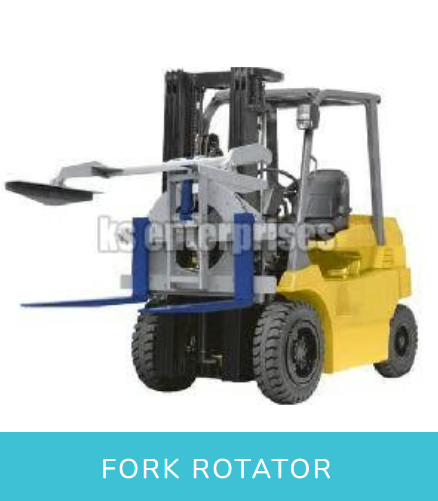 | Forklift Attachments K. S. Enterprises is a trusted supplier of premium-quality Fork Rotators, offering advanced forklift attachment solutions designed to improve... View product → |
What to Specify, Inspect and Document Before the First Shift
Write the approval specification around the load and process, not the attachment name. State:
- Load mass, centre of gravity and overall dimensions
- Fork length and fork-section dimensions
- Required rotation angle, such as 180 or 360 degrees
- Cycles per shift and whether rotation is occasional or continuous
- Retention method, including a cradle, latch, clamp or other restraint
Before acceptance, inspect the complete assembly. Confirm full carriage engagement, secure fork-retaining hardware, functioning locks and rotation stops, acceptable bearing or slew-ring play, sound gearbox operation, and an absence of structural cracks. Check hydraulic connections for leaks and inspect hoses for rubbing, crushing or chafing; a dry circuit does not prove the frame is safe.
For material handling equipment in Gurugram, make handover conditional on a written residual-capacity plate or table for the exact forklift, rotator, fork dimensions and load centre. Train named operators and record the training. Set lowered-load travel, speed limits, a marked exclusion zone and a spotter whenever the rotated load blocks forward visibility.
| Attachment | Primary change | Choose it when |
|---|---|---|
| Fork rotator | Changes load orientation | You must tip, invert or present a load face |
| Fork positioner | Changes fork spacing | You must match varying pallet or load widths |
| Combined function | Changes both orientation and spacing | The process requires both actions |
Do not approve the first shift until the operator demonstrates locking, controlled rotation, placement and return to the travel position.
Frequently asked questions
What jobs justify using a fork rotator?
A fork rotator suits jobs that require tipping, inverting or orienting loads without moving them to another machine. A 180-degree model suits a defined tipping action, while a 360-degree model suits repeated inversion or orientation at different angles.
How do you run a rotation cycle without losing load control?
Check that the load is stable, centred and secured before lifting. Raise it only as high as necessary, rotate smoothly at low speed, stop if the load shifts, and lower it after returning the forks to the required position.
How do attachment weight and load centre affect forklift capacity?
The rotator adds attachment weight and moves the combined load centre forward, reducing the forklift's available capacity. Use the forklift's attachment-specific capacity plate or obtain a revised capacity rating before lifting.
What should you check before fitting a rotator at a Gurugram site?
Measure aisle width, doorway and ceiling clearance, floor condition, turning space, charging or refuelling areas, load dimensions and the available hydraulic flow and pressure. Confirm that the rotator fits the truck, forks and planned operating route.