
A manual stacker combines a hand-operated lifting system with operator-controlled travel, so choosing one requires more than checking its advertised capacity. By the end, you will know how its hydraulic and mechanical parts work, how to operate it safely, and how to match the machine to pallets, floors, aisles and specialised loads such as forklift batteries.
Key takeaways
- Pump the handle to raise forks; steer and pull the stacker by hand.
- Check load centre, rated capacity, pallet openings and aisle width before purchase.
- Keep the load low while travelling and park with forks fully lowered.
- Choose battery lifting when loads, lift heights or duty cycles exceed manual effort.
How a Manual Stacker Lifts and Travels
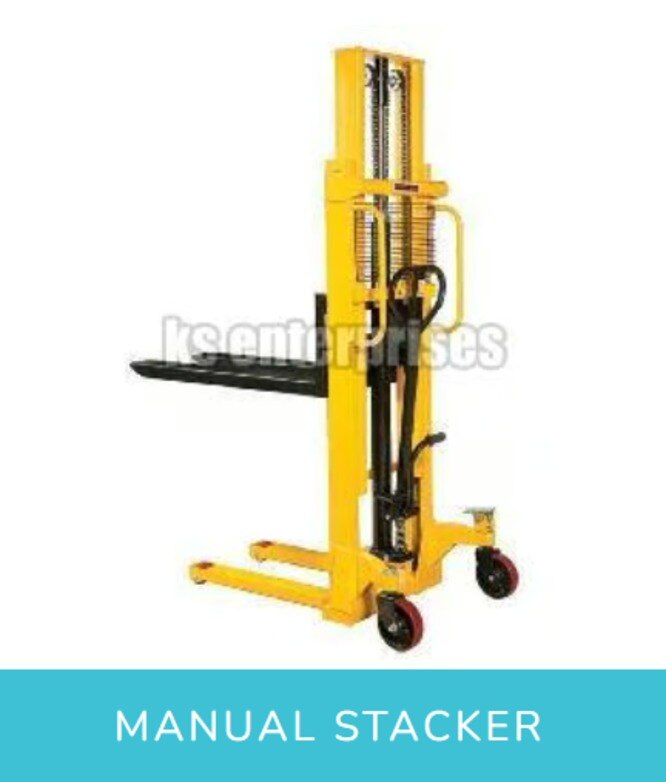
A basic manual stacker uses operator effort for both lifting and travel. The load enters the fork openings, and pumping the handle pressurises hydraulic fluid in the pump and lift cylinder, raising the forks along the mast.
The operator then pushes or pulls the unit using its handle; the load wheels and steering wheels do not drive themselves.
| Function | Manual stacker | Powered or semi-electric stacker |
|---|---|---|
| Lifting | Hand-pumped hydraulic pressure | Battery-powered lift motor, or hand pump on semi-electric models |
| Travel | Operator pushes or pulls the stacker | Battery-powered traction motor on powered models |
| Lowering and stopping | Hand-operated lowering control and brake | Controlled lowering system, traction controls and brake |
A manual stacker suits short travel distances and intermittent lifts on level, sound floors. Uneven concrete, dock edges and ramps increase rolling effort and can let the load move faster than the operator can control.
Travel with the forks low, keep the pallet against the fork back or load guard, and avoid turning with the load raised because the combined centre of gravity shifts as height increases.
Before moving, check that the pallet is centred and the forks are fully inserted. Raise only high enough to clear the floor, move slowly to the destination, apply the brake, and lower the forks completely before leaving the industrial stacker parked. A capacity plate or load chart overrides the model’s nominal rating.
The Parts That Control Lifting, Movement and Stability
The forks carry the pallet, while their spacing and full insertion determine whether the load is supported evenly. An industrial stacker’s rated capacity applies only at the stated load centre, mast height, attachment and load distribution; check the capacity plate or load chart before lifting.
- Mast and lift cylinder: The mast guides the forks vertically, and hydraulic pressure in the cylinder raises them. Worn chains, seized rollers, bent forks, cracked welds or unequal chain adjustment can make the lift uneven even when the pump works.
- Hand pump and handle: Pumping the handle sends hydraulic oil into the cylinder. The lowering control releases pressure; a leaking hose, seal, valve or cylinder can let the forks sink without warning.
- Load wheels and steering wheels: Load wheels carry weight at the fork end, while steering wheels control direction and absorb travel forces. Uneven floors, broken concrete and dock edges increase pushing effort and destabilise the load.
- Brakes: The brake holds the stacker during positioning and parking. A manual stacker gives you less braking control than a powered-travel unit, especially on a gradient.
- Stabiliser legs and safety guard: Legs widen the support footprint and resist forward tipping; the guard protects the operator from shifting material and moving mast parts.
Battery-powered travel and lift use separate electrical systems, so do not treat a manual stacker as an electric model when selecting inspections, controls or spare parts.
The Correct Operating Sequence from Pallet Entry to Parking
Check the floor and the equipment before the pallet enters. Uneven concrete, dock edges, ramps, debris and oil can increase pushing force or cause uncontrolled movement. Confirm the wheels, brake, hydraulic controls and capacity plate are intact, and that the load centre and weight fit the manufacturer’s load chart.
1. Approach the pallet squarely with the forks fully lowered. Keep the manual stacker centred on the pallet and stop before the fork tips contact the pallet boards.
2. Insert both forks fully, keeping equal engagement on each side. Partial entry can leave the pallet unsupported and allow it to slip during lifting.
3. Set the brake if fitted, then pump the handle or use the specified lift control. Raise the pallet only until it clears the floor; check that the load is centred, stable and against the fork back or load guard.
4. Release the brake and push or pull from the designated handle position. Travel with the load as low as practical, keep both forks level, move slowly over changes in floor height, and keep the route clear. Do not turn, travel on a ramp, or pass through a doorway with an elevated load.
5. Stop squarely at the destination, set the brake, and raise the pallet only enough to clear the receiving surface. Move forward until the pallet is correctly positioned, then lower the forks completely before withdrawing them.
6. With the forks clear, lower them to the parking position, apply the brake, place the controls in neutral and leave the manual stacker in its designated area. Never leave a raised load unattended or park where it blocks an aisle, exit or fire point.
If the load shifts, the floor loses traction or the stacker begins rolling, stop lowering and secure the area before continuing.
How to Match Capacity, Pallets, Aisles and Floor Conditions
Suitability starts with the actual load, not the model’s headline capacity. Record the load weight, length, width, height, centre of gravity, and how evenly the weight sits on the pallet.
Then check the capacity plate and manufacturer load chart for that load centre, mast height, attachment and fork position; a nominal 1,000 kg rating does not guarantee 1,000 kg at maximum lift.
Measure the pallet before choosing the fork arrangement. Note its entry side, fork-pocket width and height, overall footprint, and any bottom boards that could obstruct the forks. Confirm that the forks enter fully and remain centred, rather than supporting the pallet tips.
A site survey should capture these measurements:
- Narrowest aisle, turning space, doorway width and height, rack clearance, and overhead obstructions.
- Pallet height plus the required lift height, including the top of the stored load.
- Floor width, level changes, dock edges, cracks, broken concrete, ramps and drainage channels.
- Maximum gradient and the distance over which the operator must push or pull the load.
Straddle and counterbalance designs suit different clearances:
| Design | Clearance implication | Suitable access |
|---|---|---|
| Straddle-leg | Needs open space on both sides of the pallet; legs cannot pass through obstructions | Mixed pallet footprints and pallets with blocked entry areas |
| Counterbalance | Allows closer pallet access but needs rear counterweight and a larger turning envelope | Tighter pallet-side access with adequate rear clearance |
A manual stacker suits short travel and intermittent lifting on a level, sound floor. Long runs, frequent lifts, heavy loads or ramps point toward powered travel and braking.
When Battery Handling Requires a Different Stacker Specification
A forklift battery changes the specification: lifting capacity alone does not prove that a stacker is suitable. The forks must enter the battery tray, support it outside the truck, and place it without bending the tray or overloading the mast.
Before comparing an industrial stacker forklift for battery in Gurugram, provide:
- Forklift battery weight and overall length, width and height
- Required lift height and lowest fork height
- Pallet, tray or battery-rack design
- Aisle width and turning space
- Floor condition, ramps and surface joints
- Daily duty cycle and lifting frequency
- Charging method and whether work occurs inside a battery room or vehicle-maintenance area
Choose the drive system for the work, not the purchase price alone.
- Manual stacker: the operator pumps the lift and pushes or pulls the machine; suitable only when battery movement is occasional and travel distances are short.
- Semi-electric stacker: powered lifting reduces pumping effort, while travel remains manual; useful when lifting is frequent but routes are compact.
- Electric stacker: powered lift and traction reduce physical effort and improve control over repeated movement, but add battery, charger and electrical maintenance.
Check two maintenance systems: the mast, pump, chains, wheels and brakes; and the battery-charger circuit. Inspect electrolyte level where applicable, connector heating, cable damage, charger compatibility and charging access.
Ask K. S. Enterprises to identify the exact pump, mast, fork, roller, chain, hydraulic seal kit, connector and charger before ordering forklift spare parts; similar-looking parts can still be incompatible.
Related products
 | Industrial Stackers K. S. Enterprises is a trusted supplier of premium-quality Manual Stackers, providing cost-effective and efficient material handling solutions for... View product → |
 | Industrial Stackers K. S. Enterprises is a trusted supplier of high-quality Electric Stackers, offering efficient and reliable material handling solutions for... View product → |
Frequently asked questions
How does a manual stacker lift and move a pallet?
The operator pumps the handle to pressurise hydraulic fluid, which drives the lift cylinder and raises the forks. The operator then steers and travels the stacker by pushing or pulling it manually.
What parts control a manual stacker's lifting and stability?
The pump handle, hydraulic pump, lift cylinder, mast, forks, steering wheels, load wheels, brakes and chassis control lifting, movement and stability. The mast and chassis must keep the load within the stacker's rated capacity and load centre.
What is the correct operating sequence for a manual stacker?
Inspect the stacker, confirm the load and pallet are within capacity, enter the forks fully, lift only enough to clear the floor, travel with the load low, position it squarely, lower it fully and park with the forks down and the brake applied.
How do you choose a manual stacker for pallets and aisles?
Match rated capacity and load centre to the actual pallet, then check fork dimensions, maximum lift height, turning radius, aisle width, door clearances and floor condition. Uneven floors, slopes and damaged pallets can make a manual stacker unsuitable.
When does a battery-powered stacker need a different specification?
Specify battery lifting when repeated lifting, high lift heights, heavy loads or long operating cycles make hand pumping inefficient. Compare battery voltage and capacity, charger requirements, lift speed, duty cycle and available forklift battery support.
Related products
 | Industrial Stackers K. S. Enterprises is a trusted supplier of premium-quality Semi Electric Stackers, offering efficient and economical material handling solutions for... View product → |
 | Pallet Trucks K. S. Enterprises is a trusted supplier of premium-quality Hand Pallet Trucks, offering reliable and cost-effective material handling solutions for... View product → |
 | Pallet Trucks K. S. Enterprises is a trusted supplier of high-performance Powered Pallet Trucks, delivering efficient and reliable material handling solutions for... View product → |
 | Forklift Attachments K. S. Enterprises is a trusted supplier of premium-quality Fork Positioners, providing advanced forklift attachment solutions for warehouses,... View product → |