
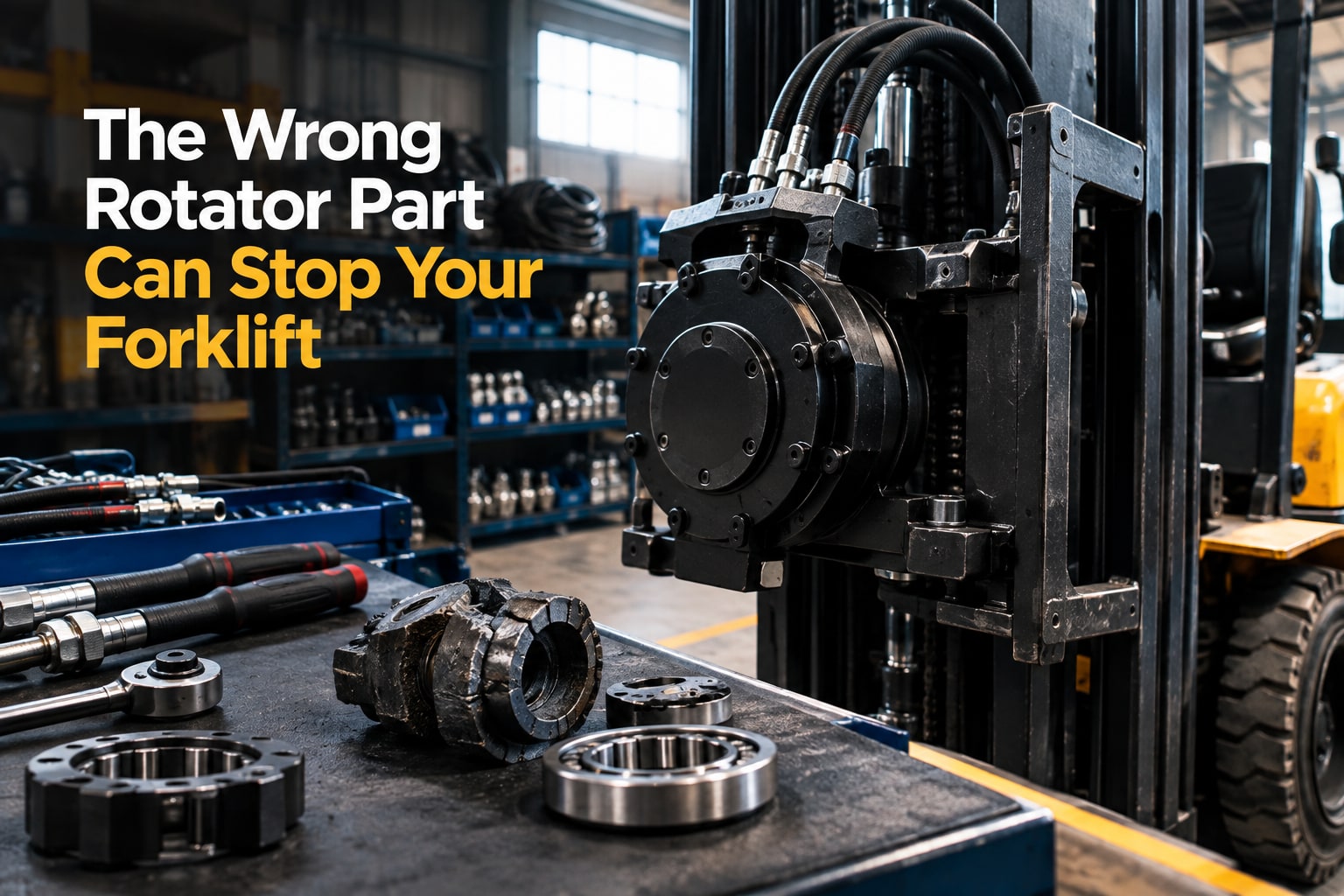
A fork rotator changes the load’s orientation, but it also changes the forklift’s capacity, hydraulic demands, visibility and maintenance requirements. You will be able to identify suitable applications, check compatibility, specify the right spare parts and decide when a fault requires immediate professional service.
Key takeaways
- Confirm attachment capacity, fork dimensions and hydraulic flow before fitting a rotator.
- Request the rotator model, serial number, load chart and installation record.
- Match replacement seals, bearings and valves to the attachment’s exact specification.
- Schedule inspections around hydraulic leaks, rotation play, braking and fork wear.
What a fork rotator does—and when another attachment is better
A fork rotator turns a properly engaged load through the attachment’s specified working angle. It does not automatically provide continuous 360-degree rotation: the design determines both the permitted angle and rotation speed.
1. Use it to turn bins, moulds, pallets, drums or containers for discharge, orientation or stacking. Confirm the manufacturer’s rotation range before planning the movement; a limited-angle unit cannot perform a full inversion, and speed affects load control.
2. Centre the load before rotating. The forks must be symmetrical, fully underneath and adequately engaged. An uneven, partly engaged or off-centre load remains unsafe even when its weight is below the rotator’s rated capacity; rotation can shed the load or side-load the attachment.
3. Choose a fork positioner when the job is changing fork spacing, not changing load orientation. Choose a side shifter for lateral alignment after picking up the load.
4. Select a bale clamp for compressed bales and a drum handler for dedicated drum work. A purpose-built tipper is the better choice when controlled dumping is the main task, rather than occasional turning with general forklift attachments.
5. For a fork rotator in Gurugram, check the attachment’s visibility obstruction, pinch zones and load-centre change before use. Operator training must cover the specific rotator, because experience with the same forklift without it does not cover the altered handling behaviour.
Compatibility and capacity checks before fitting a rotator
A rotator that fits the carriage can still be unsafe. Its own weight and the forward movement of the load centre reduce residual capacity, so the original forklift nameplate is not enough for a fork rotator in Gurugram.
1. Confirm the forklift make, model, serial number and carriage class. Match the rotator’s fork-bar and hook dimensions, mounting hardware, fork-section limits, and minimum and maximum fork spacing. Check that the forks remain fully supported and that the attachment does not block the driver’s visibility.
2. Calculate capacity for the truck-and-attachment combination. Include the rotator’s weight, the attachment load-centre distance and the intended load. Require the truck manufacturer’s written approval, then obtain a revised data plate or documented capacity information showing the permitted operation.
3. Compare the attachment’s hydraulic pressure and oil-flow limits with the truck’s available auxiliary circuit. Confirm port arrangement, hose length and routing, couplers, valve requirements, electrical controls and any required drain line before ordering forklift attachments.
4. Record the rotator model and serial number, carriage class, fork spacing and hydraulic specifications for future forklift spare parts. Do not order from a photograph or nominal size.
A rotator that appears identical can differ in carriage class, hook spacing, mounting hardware or hydraulic connections. Fitting it anyway can cause leakage, restricted movement, structural loading or loss of load control. Stop the purchase until the truck, attachment and capacity data agree.
What to request in the attachment specification and installation record
Before ordering or scheduling installation, obtain a signed attachment specification and a completion record. Use this checklist:
1. Record the maximum capacity, rated load-centre distance, rotation angle, rotation speed, carriage class, fork-spacing range, hydraulic pressure and flow, attachment weight, overall dimensions, and permitted fork-section dimensions.
2. Confirm whether the supply includes a hydraulic valve, hoses, couplers, electrical controls, drain line, mounting hardware, and installation instructions. Require written details of every change needed to the forklift’s existing hydraulic circuit.
3. Put the truck model and serial number, attachment model and serial number, installation date, capacity calculation, and post-installation functional test in the record. The test should confirm rotation, stopping, fork retention, hydraulic leak-free operation, and load control.
4. For forklift spare parts, provide the attachment serial number and manufacturer specification, not just a photograph or nominal part size. Different attachment generations that look alike can use different seals, bearings, connectors, and locking hardware; an apparently matching component can leak, fail under pressure, or release a fork.
A complete record also helps forklift service and repair personnel identify the correct pressure rating, bearing dimensions, connector type, seal material, and approved replacement part. Ask the supplier to identify each component as OEM, manufacturer-approved equivalent, or aftermarket, and to flag safety-critical parts separately from consumables.
Diagnosing rotator faults and choosing the correct spare part
Uneven rotation, failure to rotate, drift or hydraulic leakage calls for a safe isolation check, not immediate replacement of the complete attachment. Park on level ground, lower the load and forks, isolate the truck, remove hydraulic pressure according to the manufacturer’s procedure, and never work beneath a suspended load or bypass a safety device.
- Stop use for leaks, uncontrolled movement, cracked or deformed forks, failed locks, severe backlash or any load-holding fault.
- Inspect hoses and fittings for cuts, abrasion, swelling or wet connections; check fasteners, fork hooks, retention pins and locking indicators.
- Do not dismantle a pressurised cylinder or motor. A truck that rotates without a load can still creep or lose position under load.
| Fault | Likely service point | First decision |
|---|---|---|
| Uneven or noisy rotation | Bearings, thrust surfaces, bushings, hydraulic motor or gearbox | Isolate and inspect; do not load-test a noisy or binding unit |
| Leakage or drift | Cylinder seals, hoses, fittings or control valve | Stop use until pressure and seal faults are corrected |
| Excessive play | Bearings, bushings, thrust surfaces or mounting hardware | Stop for severe backlash |
| No rotation | Control valve, couplers, motor, gearbox or damaged hose | Verify controls and connections before parts ordering |
| Bent forks or locking faults | Fork-retention mechanism, hooks or locks | Remove from service immediately |
Choose forklift spare parts by attachment serial number, pressure rating, dimensions, connector type, seal compatibility and manufacturer specification—not nominal size. A quotation for Fork Rotator forklift spare parts should identify OEM, manufacturer-approved equivalent or aftermarket parts, separating safety-critical hooks, locks, forks and load-bearing components from consumables.
K. S. Enterprises can verify truck and attachment identity before dispatching parts or arranging field or workshop forklift service and repair in Gurugram. That approach supports forklift service and repair without assuming every fault needs a complete replacement.
Related product
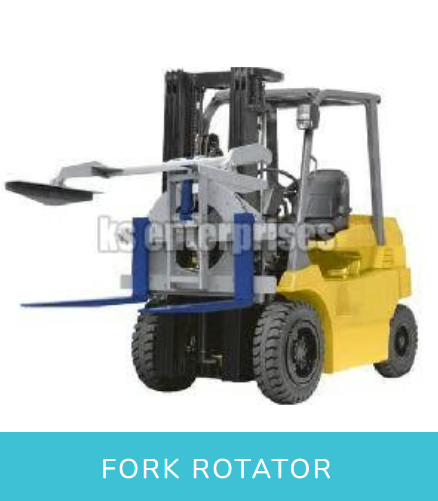 | Forklift Attachments K. S. Enterprises is a trusted supplier of premium-quality Fork Rotators, offering advanced forklift attachment solutions designed to improve... View product → |
How to plan reliable service for a rotator-equipped forklift in Gurugram
A credible service programme records both units: truck make, model and serial number; attachment model and serial number; operating hours and duty cycle. Note indoor or outdoor use, dust, monsoon moisture, cold-store or corrosive exposure. Log hydraulic leaks, rotation noise, backlash, drift, fork-retention condition and hose condition.
1. Examine the truck daily and at each end of shift when it runs around the clock. Correct safety defects before return to service, not after the next planned visit.
2. During major attachment work, inspect brakes, steering, tyres, mast chains, lift cylinders, warning devices, seat restraint and battery-charging controls. After repair, document the functional or load test, including whether the rotator holds position without leakage or drift.
3. For electric trucks, check charging-area ventilation, fire protection and no-smoking or open-flame controls. Hydrogen accumulation can create an explosion hazard.
4. Mobile service suits routine inspections, hose or fitting replacement and minor adjustments when the truck can be isolated safely. Remove the attachment to a workshop for controlled load testing, attachment removal or structural repairs; field work can leave unsafe access or inadequate test equipment.
Ask a local forklift service and repair provider for dated inspection sheets, parts and test records, identified defects, corrective actions, technician findings and a clear return-to-service decision. Set response standards for emergency safety faults, routine attendance, parts availability and written escalation when workshop repair is needed.
Choose forklift service and repair in Gurugram that provides records, not an invoice alone.
Frequently asked questions
What does a fork rotator do, and when is another attachment better?
A fork rotator turns an engaged load through its specified working angle. Choose a sideshifter for lateral positioning, a clamp for non-palletised loads, or a tipper when controlled dumping is the main task.
What compatibility checks are needed before fitting a fork rotator?
Check the forklift’s rated capacity at the attachment load centre, carriage class, fork dimensions, hydraulic flow and pressure, attachment weight, and visibility limits.
What should an attachment specification and installation record include?
Request the make, model, serial number, rated capacity, working angle, rotation speed, load centre, hydraulic requirements, mounting details, test results and installer’s sign-off.
How do you diagnose a fork rotator fault?
Separate hydraulic, mechanical and control symptoms: inspect leaks and pressure for slow rotation, bearings and drive components for play or noise, and valves or hoses for uneven movement.
How should you plan fork rotator service in Gurugram?
Keep the attachment model and serial number with service records, inspect before each shift, schedule hydraulic and mechanical checks, and stock critical forklift spare parts matched to the unit.