
A manual stacker is more than a pallet truck with taller forks: it combines pedestrian travel with hydraulic lifting to place palletised loads above floor level. By the end, you will know how its parts work, where it fits in a warehouse, what limits to check, and how to specify one safely.
Key takeaways
- Check load centre, lift height and pallet dimensions before choosing.
- Use level floors, clear aisles and stable loads during operation.
- Choose a manual stacker when throughput is low and travel distances are short.
- Confirm service support, spare parts and specifications before buying in Delhi.
What a Manual Stacker Is and How Its Parts Work
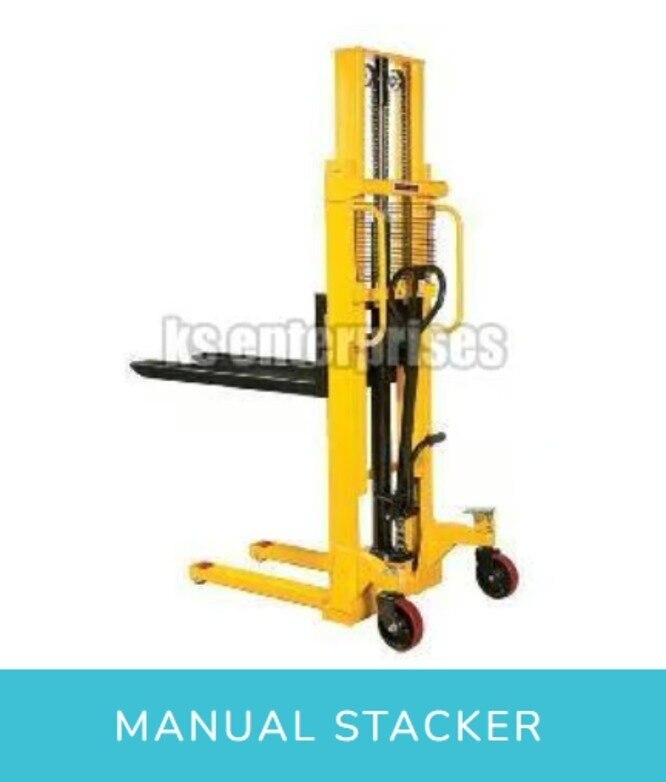
A manual stacker is a pedestrian-operated industrial truck for short-distance pallet handling and low-to-moderate throughput. It uses forks or another load-supporting attachment to raise loads hydraulically and place them in a rack, on a stack, or at a low dock.
For anyone asking what is a manual stacker for industrial material handling equipment, the answer is a walk-behind machine, not a ride-on counterbalanced forklift.
“Manual” describes how the unit travels and lifts. A fully manual pump stacker moves when you push or pull it and raises the forks with a hand pump or foot pump. A hand-propelled stacker with electric lift still requires walking effort for travel but uses a battery and control for fork movement.
Identify these working parts:
- Mast: guides the forks vertically.
- Forks: enter beneath and support the pallet.
- Load backrest: helps prevent the load shifting toward the operator.
- Hydraulic pump: converts pumping action into lifting force.
- Tiller or handle: controls steering and movement.
- Steering wheels and load wheels: guide and carry the machine.
- Lowering control: releases hydraulic pressure for descent.
- Parking brake and stabilisers or adjustable legs: hold the unit steady where fitted.
Use it by approaching squarely, inserting both forks fully, centring the load, applying the brake, raising it only enough to clear the floor, pushing to the destination, lowering it through controlled hydraulic release, and withdrawing the forks.
How to Operate a Manual Stacker in a Warehouse
Use a manual stacker for warehouses by pushing or pulling it to the pallet, raising the load with a hand or foot pump, and lowering it through a controlled hydraulic release. Travel remains manual; some models use a separate electric lift control.
Check that the floor is flat and firm before moving, because small wheels handle broken concrete, loose surfaces, thresholds, and steep ramps poorly.
- Position the forks squarely with the pallet and insert both forks fully.
- Centre the load, apply the parking brake, and pump only until the pallet clears the floor.
- Release the brake, push the stacker to the destination, and keep the load low during travel.
- Stop straight on, apply the brake, raise the pallet to the required level, and place it on the rack or stack.
- Lower the forks fully before pulling them out; do not drag the pallet sideways.
Common manual stacker uses include short-distance pallet movement, rack replenishment, work-in-process transfer, low-dock loading, and handling dies or rolls with a suitable attachment.
| Job | Suitability | Practical limit |
|---|---|---|
| Pallet stacking | Good | Best at low-to-moderate throughput |
| Rack replenishment | Good | Confirm aisle, pallet, and rack clearance |
| Work-in-process movement | Good | Keep travel distances short |
| Outdoor yard work | Poor | Wheels and gradients limit control |
| Continuous loading | Poor | Powered equipment suits repeated travel better |
Where a Manual Stacker Fits Compared with Other Trucks
A manual stacker sits between a hand pallet truck and a powered forklift. It adds a mast and lifting range for placing pallets on racks, but the operator still pushes or pulls the truck and, on a fully manual model, pumps a handle or foot pedal to raise the forks.
| Option | Main difference | Suitable work |
|---|---|---|
| Hand pallet truck | Lifts a pallet only enough to clear the floor; it has no stacking mast | Moving pallets horizontally over short distances |
| Manual stacker | Uses pedestrian travel and hydraulic hand or foot pumping; hand-propelled versions can have electric lift | Occasional pallet stacking at low-to-moderate throughput |
| Electric or semi-electric stacker | Uses electric lift, electric travel, or both, reducing pumping and pushing effort | Repeated stacking, longer travel, and higher daily cycle counts |
| Counterbalanced forklift | Uses a powered drive system and rear counterweight to carry loads beyond the front axle | High-throughput loading, continuous travel, outdoor yards, and heavier loads |
A manual stacker usually needs less turning space than a counterbalanced forklift, but truck width alone does not establish the aisle requirement. Check the pallet size, rack clearance, turning geometry, operator position, and whether the forks must approach straight-on.
The trade-off is effort. Repeated pumping and pushing over poor floors, ramps, or a full shift reduces productivity and increases ergonomic strain; choose powered assistance when travel frequency or load weight makes that effort continuous.
What to Specify Before Buying a Manual Stacker in Delhi
Give the supplier operating facts, not only the words “manual stacker”. For industrial material handling equipment in Delhi, state the pallet type and dimensions, total load weight, load-centre distance, required lift height, aisle width, and daily lifting cycles.
- Describe the floor: smooth concrete, broken concrete, expansion joints, thresholds, ramps, loose surfaces, gradients, and required ground clearance.
- Specify fork length, fork width, minimum and maximum fork adjustment, wheel material, and any corrosion from chemicals, moisture, or wash-down cleaning.
- Confirm whether the operator will push and pump manually, or push manually while using an electric lift.
- Give the narrowest aisle and doorway, the highest stacking location, and the time or distance between lifts.
| Operating detail | Standard manual choice | Reconsider or specify |
|---|---|---|
| Pallet and load | Standard pallet with a centred load | Uneven pallets, long loads, or a load centre beyond the rated figure |
| Floor and route | Flat concrete with short travel | Broken floors, steep ramps, loose ground, or heavy thresholds |
| Work rate | Occasional stacking and short moves | Continuous loading, outdoor yard work, or high daily cycles |
| Lift requirement | Hand-pump height within the rated capacity | Frequent lifting that justifies electric lift assistance |
Ask a manual stacker supplier in Delhi to quote seals, pump components, wheels, bearings, chains, forks, and hydraulic oil separately, with spare-parts lead times, warranty exclusions, inspection support, and technician coverage.
K. S. Enterprises can be compared on these service details rather than purchase price alone, because a proprietary seal or wheel that takes weeks to arrive can stop a low-cost unit.
Related product
 | Industrial Stackers K. S. Enterprises is a trusted supplier of premium-quality Manual Stackers, providing cost-effective and efficient material handling solutions for... View product → |
Manual Stacker Safety Checks and Operating Limits
A manual stacker is fit for use only after you confirm its structure, controls, wheels, brakes, load capacity and route. Check the nameplate before lifting: capacity changes with the load centre and lift height, so a pallet within its weight limit can still overload the machine.
- Inspect forks, welds, mast, chains or hydraulic components for cracks, bends, loose parts or leaks.
- Test the lowering control, hand or foot pump, steering handle and parking brake before entering the work area.
- Check steering wheels, load wheels, stabilisers and adjustable legs for damage, excessive wear and secure attachment.
- Keep the load centred, stable and fully supported by both forks; never exceed the rated load centre.
- Travel with the load as low as practical, brake before raising or lowering, and keep people away from the load and mast.
- Remove the stacker from service if it has a hydraulic leak, bent fork, damaged wheel, faulty brake or uncontrolled lowering.
| Condition | Control | Stop or reject when |
|---|---|---|
| Uneven floor, threshold or expansion joint | Cross squarely at low speed; confirm ground clearance | Wheels catch, lift, or lose contact |
| Ramp or gradient | Use only within the manufacturer’s stated limit | The route exceeds that limit or traction is uncertain |
| Side load or off-centre pallet | Reposition and centre the pallet before lifting | The load shifts, extends beyond the rated envelope, or needs force |
| Outdoor, loose or broken surface | Use equipment and wheels approved for that surface | Small wheels sink, skid or strike obstacles |
| High-throughput travel | Use short-distance, low-cycle work only | Continuous movement or powered-truck performance is required |
Frequently asked questions
What is a manual stacker used for?
A manual stacker moves pallets short distances and raises them for low-to-moderate stacking, rack placement or low-dock work.
How do you operate a manual stacker safely?
Inspect the forks, hydraulic system, wheels, brakes and load before use. Keep the load centred, travel with forks low and avoid exceeding the rated capacity.
How does a manual stacker compare with other warehouse trucks?
A manual stacker suits lower throughput and shorter travel than an electric stacker or forklift. It costs less to run but requires pedestrian effort and offers slower handling.
What should you specify before buying a manual stacker in Delhi?
Specify rated capacity, load centre, lift height, fork dimensions, minimum aisle width, pallet type, floor condition and the availability of local service and parts.