
A brick block clamp is chosen around the shape, weight and stability of the masonry load, not simply its advertised tonnage. By the end, you will know what the attachment must grip, which forklift measurements and specifications to verify, how to prevent product damage, and what a complete supplier offer should include.
Key takeaways
- Grip stable packs with enough side area for even pad contact.
- Request load dimensions, weight, centre of gravity and clamp capacity.
- Match attachment weight and hydraulic requirements to the forklift data plate.
- Test pressure and travel slowly to prevent cracking, slipping and marks.
What Load Geometry Is a Brick Block Clamp Designed For?
Hydraulic clamp arms close around the load, so the forklift lifts and places it without inserting forks under a pallet. A brick clamp for construction suits stable packs with enough side contact area for both pads to grip evenly.
Palletised masonry with clear fork pockets is usually better handled by standard forks; use a clamp only when the route is level and the combined load remains within the attachment rating.
Suitable load geometry includes:
- Banded brick packs and bundled bricks
- Concrete blocks and AAC blocks
- Pavers and other stable, compact unit loads
- Packs whose opposite sides are flat enough for even pad contact
Do not clamp irregular debris, loose damaged masonry, wet or unstable stacks, fragile unstrapped packs, or shapes that leave gaps beneath the pads. These loads can slip, crumble or suffer concentrated crushing when pressure is applied.
| Option | Gripping method | Suitable geometry and main risk |
|---|---|---|
| Purpose-built brick clamp | Hydraulic side pressure | Masonry packs and blocks; excessive pressure can crack units or crush hollow webs |
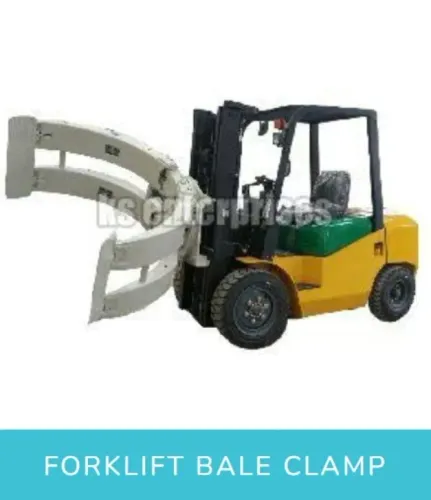
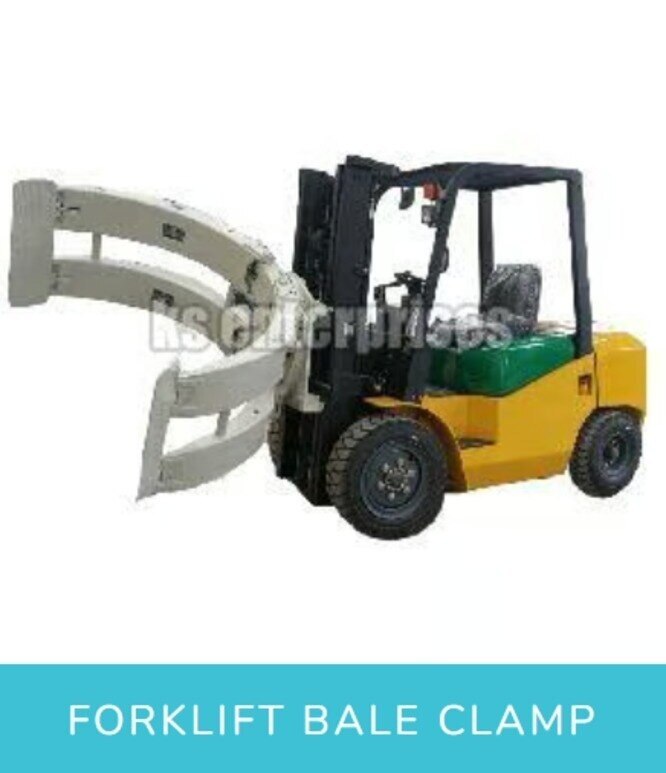
| Bale clamp | Broad padded side pressure | Compressible, fibrous bales; rigid masonry may slip or receive uneven force |
| Fork positioner | Adjustable forks enter beneath the load | Pallets or loads with fork openings; it cannot safely grip a pallet-free pack from the sides |
| Standard forks | Tines support from below | Palletised masonry with clear pockets; damaged pallets or poor fork entry can cause tipping |
Even a suitable pack becomes a poor clamp load if the attachment exceeds its rated capacity or the site route has potholes, slopes or sharp turns.
Which Load Measurements and Clamp Specifications Must You Request?
Give the supplier the actual masonry package, not just a required tonnage. Provide individual brick or block length, width and height; pack length and width; stack height; total weight; centre of gravity; packaging or banding method; surface texture; and the smallest load the arms must close around.
State allowable compression for hollow, AAC or lightweight blocks.
The quotation from a forklift manufacturer for brick block clamp in Delhi should state:
- Rated capacity at a named attachment load centre
- Minimum and maximum opening, plus capacity at each relevant opening
- Arm length, arm clearance, and pad length, width and height
- Attachment weight and the forklift’s residual capacity after installation
- Required hydraulic pressure, flow rate and pressure-regulation method
- Whether the truck needs a third auxiliary hydraulic function
- Integrated sideshift weight and its effect on load centre, if selected
An “X-ton clamp” description is incomplete. A taller pack or a pack carried farther forward increases overturning moment, so the forklift’s residual capacity can limit the lift before the clamp reaches its own rating. Hollow or lightweight blocks can also tolerate less compression than dense, banded bricks.
| Pad option | Best fit | What to confirm |
|---|---|---|
| Replaceable rubber | Finished bricks and smooth blocks | Wear, oil contamination and replacement cost |
| Non-marking rubber | Pale or surface-sensitive masonry | Grip at the stated load and pressure |
| Hard or profiled | Rough, dusty masonry | Contact pattern and risk of face damage |
How Do You Prove That the Clamp and Forklift Are Compatible?
Compatibility is proven only when the installed combination passes dimensional, hydraulic, capacity and site checks. A forklift manufacturer for brick block clamp in Delhi must inspect the truck, attachment and actual load together; a clamp that hangs on the carriage can still be unsafe or unusable.
- Confirm ISO 23206 or equivalent carriage dimensions, carriage class, hook spacing, lower hook clearance, locking points and visibility around the attachment frame.
- Verify auxiliary hydraulic pressure and flow, valve arrangement, hose routing, abrasion protection, pinch-point clearance and any electrical or third-function interface.
- Calculate residual capacity using the truck, clamp weight, attachment load centre and actual brick or block load. Do not use the original fork-only nameplate.
- Require a revised capacity or data plate and load chart for the installed combination, issued after competent installation and testing.
- Check mast-stage clearance, turning space, overhead obstructions and driver visibility with the loaded clamp in the intended Delhi warehouse or construction-site route.
Compare sideshift arrangements before approving a brick block clamp in Delhi:
| Option | What changes | What to require |
|---|---|---|
| Integrated sideshift | Adds attachment weight and can move the load farther forward | Residual-capacity calculation and revised load chart |
| Separate sideshifter | Adds another attachment and greater forward projection | Combined weight, load-centre calculation and carriage-clearance check |
| No sideshift | Lowest added weight, but placement depends on truck positioning | Confirm turning room, visibility and accurate load placement |
How Should Operators Prevent Cracking, Slipping and Clamp Marks?
Prevent cracking, slipping and clamp marks by controlling the attachment, load, clamp pressure and travel conditions before every lift. A clean, correctly adjusted clamp grips evenly; a damaged pad or unstable pack can fail during braking.
1. Inspect the attachment, pads, locking devices, cylinders, seals and hydraulic hoses. Remove embedded aggregate from the pads. Replace pads with uneven wear, oil contamination or damaged surfaces.
2. Confirm that the pack is stable and banded when required. Check its size and weight against the approved opening range and attachment rating. Reject loose, wet, damaged or leaning masonry.
3. Centre the clamp on the pack, then close both arms evenly. Use the regulated pressure setting specified for that load: too little pressure permits movement, while too much pressure can crack bricks, crush block webs, mark finished faces or distort packaging.
4. Raise the load slightly and perform a stability check. Stop if the pack shifts, tilts, leaks or opens the clamp; do not continue by increasing pressure without identifying the cause.
5. Travel with the load low and at a speed suited to the route, braking points and turns. Sudden braking can turn a marginal grip into a dropped load.
6. Place the pack onto full support before opening the arms. Never release it while part of the load remains suspended.
Commissioning must use representative brick, block or paver packs, not an empty clamp cycle. Acceptance checks should record leakage, unintended opening, pressure setting, opening range, load shift during travel, safe placement at stacking height and the truck’s capacity at the intended load centre.
What Should a Complete Brick Clamp Supplier Offer?
A forklift attachment manufacturer in Delhi or its distributor should supply an engineered package, not an unverified clamp. Require site measurement, application review, dimensional drawings, compatibility confirmation, pressure and pad selection, competent technician installation, protected hoses, commissioning and operator instruction.
Before approval, require these documents and checks:
- Revised capacity plate and load chart for the actual truck, attachment and load
- Rated capacity at the stated attachment load centre, opening range, pad dimensions and attachment weight
- Hydraulic pressure and flow requirements, third-function requirements and a documented pressure-setting procedure
- Spare-part identification, replacement pads, seals and hoses
- Periodic inspection intervals and repair support
Acceptance testing must use the actual brick, block or paver packs, not an empty clamp cycle. Confirm residual capacity, hydraulic performance, leakage, locking devices, unintended opening, approved opening range and representative lifting cycles at the intended stacking height.
A brick block clamp in Delhi should also be judged by its operating result. Compare the complete cost, including:
| Cost item | What to record | Why it changes the decision |
|---|---|---|
| Breakage and rehandling | Damaged packs, extra handling cycles | Poor pressure or unstable loads erase purchase savings |
| Wear consumption | Pad, seal and hose replacements | Dust, broken masonry and monsoon moisture accelerate wear |
| Truck utilisation | Loads moved per shift and idle time | A slow or poorly matched clamp reduces available capacity |
| Return loads | Mixed-size packs handled without adjustment | Limited range creates double handling and empty return trips |
K. S. Enterprises is a Delhi-based equipment supplier to approach when you need this attachment, installation and support scope verified together.
Related product
 | Forklift Attachments K. S. Enterprises is a trusted supplier of high-quality Brick Block Clamps, offering advanced material handling solutions for the construction,... View product → |
Frequently asked questions
What load geometry is a brick block clamp designed for?
It suits stable, regularly shaped brick or block packs with flat, parallel sides and enough contact area for both hydraulic pads to grip evenly.
Which measurements and specifications should you request?
Request pack length, width, height, weight, centre of gravity, pad dimensions, opening range, rated capacity, attachment weight and required hydraulic pressure and flow.
How do you prove that a clamp and forklift are compatible?
Check the forklift data plate, attachment rating and supplier drawings for capacity at the actual load centre, residual capacity, mounting class, hydraulic connections and pressure or flow limits.
How can operators prevent cracking, slipping and clamp marks?
Centre the pack, align both pads, use only the specified pressure, lift smoothly, keep the load low while travelling and stop if the pack shifts or shows damage.
What should a complete brick clamp supplier offer?
Ask for a clamp matched to the load and forklift, compatibility calculations, mounting and hydraulic details, operating instructions, inspection guidance, spare parts and service support.