
A fork rotator can empty, invert or reposition a container, but a hydraulic fault, poor fork engagement or an incorrect capacity assumption can turn that task into a falling-load or truck-stability incident. By the end, you will be able to identify the main failure modes, isolate hydraulic and mechanical causes, verify capacity and fitment, and specify the documents and support a supplier must provide.
Key takeaways
- Stop operation after hydraulic leaks, uncontrolled rotation or abnormal noise.
- Recalculate capacity using attachment weight, load centre and residual capacity.
- Confirm carriage class, hydraulic flow, fork size and locking points before commissioning.
- Require test records, manuals, inspection intervals and response terms from your supplier.
What a fork rotator does, and when you should use one
A fork rotator attachment turns a suspended load through a specified angle, such as 180° or 360°, so you can empty, invert, orient or reposition it. It suits tipping bins, waste containers, mould boxes, drums, pallets and process containers when the task requires controlled rotation.
| Load or task | Use a fork rotator | Keep standard forks |
|---|---|---|
| Tipping or inverting | Empty bins, drums or process containers | No rotation required |
| Orienting or repositioning | Turn mould boxes, pallets or containers to a set angle | Stable, conventional loads handled upright |
| Routine lifting and travel | Only when rotation is part of the job | Normal pallets, cartons and rigid loads |
A rotator is not automatically a clamp, stabiliser or load restraint. Keep the load centred, supported by both forks and against the attachment back where applicable; secure it when its shape, centre of gravity or packaging could permit movement. Do not rotate from the fork tips, side-load, shock-load, snagged loads or unstable loads.
Fork rotator attachment problems can begin with a shifted load, then worsen through altered load centre, reduced residual capacity, inadequate overhead clearance or a racking collision. Check clearance before rotating. Hydraulic pressure loss can also let the load move, so never treat hydraulic holding as restraint.
Stop if the attachment detaches, the load drifts or movement becomes uncontrolled.
How to recognise and isolate fork rotator failures
Incomplete rotation, jerky movement, hydraulic leaks, load drift, weak clamping, unusual noise, excessive side play, fork-locking failure, damaged fork pockets or attachment detachment are fork rotator attachment problems, not one diagnosis. Hydraulic symptoms usually change with oil supply or controls; mechanical and application faults remain after the circuit passes inspection.
1. Stop work and remove the attachment from service for any leak, uncontrolled drift or damaged retention hardware. Do not reduce the load informally and continue operating.
2. Check oil level and condition, hose abrasion, fittings, swivel components, quick-coupler seating, auxiliary pressure and flow, relief-valve operation, back-pressure, return-line connection and cylinder leakage. Low auxiliary flow, contaminated oil or an incorrectly connected return line can mimic attachment failure.
3. With hydraulic supply verified, inspect gearbox wear, bearing play, structural welds, rotation end-stops, locking features, fork-locking pins, hook engagement, fork distortion and load balance. A sound circuit cannot correct a worn gearbox, disengaged hook or off-centre load.
4. Confirm the load remains supported by both forks and is not snagged, side-loaded or rotated from the fork tips. Check whether the failure appears only at a particular load-centre distance, rotation angle or temperature.
Record photographs, the attachment serial number, truck hours, load weight and dimensions, load-centre distance, fork spacing, temperature, maintenance history and whether the fault appeared during lifting, travel or rotation. Give these records to fork rotator support before replacing parts.
How capacity changes after fitting the attachment
The safe operating rating is the combined truck-and-attachment rating, not the lower or higher of two nominal tonne figures. Attachment weight consumes capacity, while its thickness and forward projection move the effective load centre farther from the mast.
1. Read the forklift nameplate for the truck’s rated capacity, lift height and specified load-centre distance. Do not use the truck’s basic capacity alone.
2. Read the attachment capacity plate for its weight, capacity, fork spacing limits and load-centre distance. A rotator rated at one load centre does not keep that rating at a longer projection or different spacing.
3. Require the combined truck-and-attachment rating at the actual load centre, lift height, fork spacing and each applicable rotation position. The attachment manufacturer or installer must provide this revised capacity, weight and load-centre information on a marking or data plate.
4. Confirm that the revised rating also supports braking, residual stability and visibility. A truck that lifts the weight can still be unsafe if the rotator blocks the travel path or shifts the centre of gravity forward.
For operations governed by OSHA, 29 CFR 1910.178(a)(4) requires the manufacturer’s prior written approval for modifications affecting capacity, safe operation or visibility. Mark the modified truck with the attachment and revised rating.
Obtain local approval from the forklift manufacturer or a competent engineer where the jurisdiction requires it, and choose a forklift attachment manufacturer for fork rotator failures that documents these ratings rather than supplying a catalogue figure.
How to confirm fitment before commissioning
Give the forklift attachment manufacturer in Delhi a complete specification before fabrication or selection. Include:
1. Forklift make and model; rated capacity; hydraulic circuit pressure and flow; oil specification; connection type; fork-section dimensions; carriage class; load weight; load-centre distance; rotation angle; duty cycle; and container dimensions.
2. Confirm mechanical fit beyond fork length. Check carriage class, upper and lower hook geometry, hook spacing, fork-pocket clearance, permissible fork spacing, retaining devices, locking points, hydraulic couplings, hose routing, operator visibility, and clearance from racking or overhead structures.
3. Request a compatibility drawing, installation instructions, capacity plate, operating manual, inspection record, model-specific load chart, hydraulic requirements, replacement-part identification, warranty exclusions, and a documented commissioning or proof-load procedure. A generic catalogue rating is not proof of fitment.
4. Accept the rotator only after a no-load inspection. Verify the capacity plate, attachment identification, fork retention, carriage engagement, hoses, couplings, leaks, abnormal play, structural welds, controls, and rotation stops or locking features.
5. Inspect the fork arms to ISO 5057, paying particular attention to heel and shank wear, cracks, bending and section loss. Record the findings before use.
6. Test rotation without a load, then follow the approved proof-load procedure. Confirm smooth movement, full stops and secure retention; stop commissioning if the attachment detaches, leaks or develops uncontrolled movement.
7. Where OSHA applies, complete the powered-industrial-truck examination before service each day, or after each shift for round-the-clock use. Record defects and remove unsafe equipment from service.
What to require from a fork rotator supplier in Delhi after installation
Require a support arrangement, not just a delivery address. A fork rotator supplier in Delhi must prove compatibility with your truck and load; location, “advanced” or “premium-quality” claims, and a generic catalogue rating do not establish fitment or a defined safety rating.
K. S. Enterprises is useful when its supply process includes model-specific fitment checks, revised capacity information, commissioning, and continuing fork rotator support rather than a parts-only response.
Ask for:
- An identified repair route, response contact, and escalation process
- Spare seals, hoses, swivel assemblies, proprietary wear parts, and replacement-part identification
- Inspection intervals, operator instructions, hydraulic requirements, and commissioning records
- Warranty exclusions covering overload, incorrect fitment, contamination, misuse, and unauthorised modification
- A written review process for repeated leaks, drift, abnormal play, hose damage, or detachment
The investigation must classify the cause before anyone replaces a component.
| Failure category | Evidence to review | Corrective focus |
|---|---|---|
| Structural failure | Welds, housing, bearing seats, fracture photographs | Load, impact, fatigue, or manufacturing defect |
| Hydraulic failure | Hoses, swivel, couplings, oil, pressure, return line | Leakage, contamination, flow, or relief-valve fault |
| Retention failure | Hooks, pins, fork pockets, locking hardware | Fitment, wear, engagement, or damaged retention |
| Application error | Load weight, dimensions, centre, fork spacing, task records | Overload, imbalance, snagging, or unsuitable use |
Record the attachment serial number, truck hours, load data, temperature, maintenance history, and whether the fault occurred during lifting, travel, or rotation. Base the decision on documented truck data, attachment ratings, installation evidence, and the support plan—not on the phrase “fork rotator supplier in Delhi” alone.
Related product
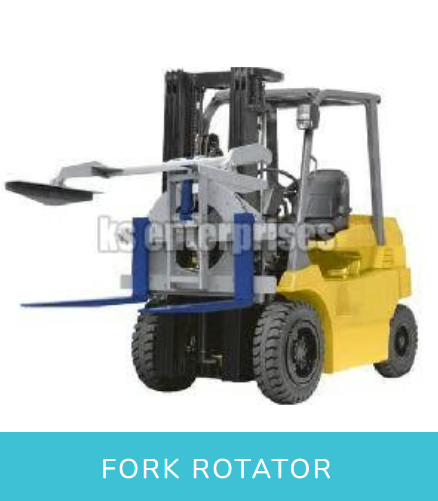 | Forklift Attachments K. S. Enterprises is a trusted supplier of premium-quality Fork Rotators, offering advanced forklift attachment solutions designed to improve... View product → |
Frequently asked questions
What does a fork rotator do, and when should you use one?
A fork rotator turns a suspended load through a specified angle, such as 180° or 360°. Use it for controlled emptying, inversion, orientation or repositioning of bins, drums, mould boxes, pallets and process containers.
How do you recognise and isolate fork rotator failures?
Stop using the attachment after uncontrolled movement, hydraulic leakage, abnormal noise, uneven rotation, damaged forks or a faulty locking mechanism. Park safely, lower the load, isolate hydraulic power and have a qualified technician inspect the attachment.
How does a fork rotator change forklift capacity?
The attachment adds weight and moves the load centre forward, reducing residual forklift capacity. Check the forklift data plate, attachment rating and revised capacity calculation for the actual load centre before lifting.
What should you confirm before commissioning a fork rotator?
Confirm the carriage class, fork-pocket dimensions, fork length, hydraulic connections, required flow and pressure, locking points, visibility, rated load and rotation angle. Complete a no-load and controlled-load function test.
What should you require from a fork rotator supplier in Delhi after installation?
Require installation records, operating and maintenance manuals, rated-capacity information, inspection intervals, spare-parts details, technician contact information and a documented response process for fork rotator support.